

 My Account
 Our Story
 The Science
 Shipping Information
 Returns
 FAQ
FAQ VIP Rewards
 Contact Us

How to Build a Vitamin C Skincare Routine: Step-by-Step
Learning how to build a skincare routine with vitamin C layering done correctly is one of the most impactful decisions you can make for your skin. Most people apply a vitamin C serum in roughly the right place — before moisturizer, after washing their face — but "roughly right" leaves significant efficacy on the table. L-ascorbic acid (LAA), the only form of vitamin C with documented clinical performance, is pH-sensitive, sequence-dependent, and easily degraded by formulation errors or poor layering habits. This guide walks through every step of a clinical vitamin C routine, from cleanse to SPF, so each product you apply works at its full potential.
Why Routine Architecture Matters for Vitamin C
L-ascorbic acid absorbs into skin most effectively when the skin surface pH is below 3.5. Research published in the Journal of the American Academy of Dermatology — including foundational work funded by the National Cancer Institute and conducted with involvement from Dr. Mostafa Omar, who founded Phyto-C Skin Care — established that both concentration and pH are non-negotiable variables for topical vitamin C efficacy. Apply LAA over a high-pH surface and absorption drops substantially. Apply it in the wrong sequence alongside incompatible actives, and you risk either irritation or reduced activity.
Routine architecture is not a premium add-on. For a clinical-grade antioxidant like pure L-ascorbic acid, it is a prerequisite. To understand why vitamin C serum pH determines whether it actually works, it helps to see how each step in a routine either supports or undermines that chemistry.
Step 1: Cleanse and Tone Before Your Vitamin C Serum
Tap water has a pH between 6.5 and 8.5 — far above the 3.5 threshold LAA needs. Even after rinsing with a well-formulated cleanser, residual alkalinity can persist on the skin surface. That is why a mild AHA toner is a functional step, not a cosmetic one.
The Balancing Toner from Phyto-C contains citric acid, glycolic acid, and lactic acid — a combination designed to acidify the skin surface and prime it for vitamin C absorption. Apply it after cleansing, allow 30–60 seconds for it to fully absorb, then proceed to your serum. This short wait is meaningful: it lets the toner do its pH-lowering work before the vitamin C serum arrives.
Step 2: Choose the Right Vitamin C Serum for Your Skin
Vitamin C serum selection should be based on skin tolerance, experience level, and treatment goals — not marketing. The concentration ladder at Phyto-C is straightforward.
Sensitive or first-time users: Start at 10%. E in C Lite — formulated by Dr. Eddie Omar, CEO and Chief Scientist of Phyto-C — delivers 10% L-ascorbic acid alongside 5% vitamin E (alpha-tocopherol) and bioflavonoids in a water-based vehicle. It is the entry-level clinical serum, designed specifically for reactive skin or anyone building vitamin C tolerance. For those who want to step up to 15% without the vitamin E component, Serum Fifteen is the next option. As you develop tolerance, read the full guide to E in C Lite for sensitive skin before advancing your concentration.
Tolerant or experienced users: Serum Twenty delivers 20% L-ascorbic acid in a simple, alcohol-free formula. For those who also want concurrent vitamin E synergy at full strength, E in C Advanced — also invented by Dr. Eddie Omar — combines 20% LAA with 5% alpha-tocopherol. The C + E combination offers additive antioxidant protection documented in published photobiology research. For a deeper look at how these two serums compare, see E in C Advanced: the clinical vitamin C + E serum.
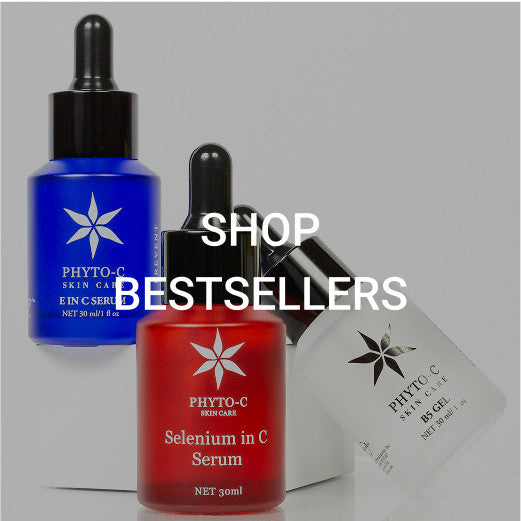
Multi-active users: Selenium in C adds 1% retinol and 1% L-selenomethionine to a 15% LAA base for a triple antioxidant system. SuperHeal O-Live Serum stacks 15% LAA with 1% retinol, alpha-arbutin, and kojic acid for simultaneous brightening support.
One point that is not negotiable: only pure L-ascorbic acid has clinical demonstration of efficacy in skin. Derivatives — ascorbyl glucoside, magnesium ascorbyl phosphate, ascorbyl palmitate, and others — have not replicated LAA's performance in published comparative research. They are not equivalent alternatives. The clinical evidence separating L-ascorbic acid from vitamin C derivatives is unambiguous on this point.
Step 3: Apply Vitamin C Correctly — Technique and Timing
Dispense 3–4 drops onto fingertips and press the serum gently into the face and neck. Do not rub vigorously. Aggressive rubbing generates friction and heat, neither of which benefits a pH-sensitive formula. Press, smooth, let it sit.
Allow 60–90 seconds of dwell time before applying anything else. This gives the serum time to settle at low pH against the skin surface. Rushing the next layer on top disrupts that window. Morning application is the clinical preference: vitamin C's antioxidant activity — its ability to help neutralize free radicals generated by UV exposure — is most strategically deployed before UV contact, not after.
Step 4: Layer Hydration and Barrier Support Over Vitamin C
Once your vitamin C serum has set, lightweight hydrating layers can follow without conflict. HYPER Hydrate, developed by Dr. Eddie Omar, delivers H2A2 hyaluronic acid, niacinamide (B3), and pantothenic acid (B5) in a concentrated 15ml booster format — an ideal second layer for added moisture retention. B5 Gel offers a simpler hyaluronic acid and pantothenic acid option for those who prefer minimal layering.
Heavier barrier creams follow last in the morning sequence. SuperHeal O-Live Lotion — reformulated by Dr. Eddie Omar — provides ceramide III, ceramide II, vitamin E, and olive leaf extract in a lightweight moisturizer format. Intensive Hydrating Cream offers a richer barrier option with ceramide 3 and amino acids for drier skin types.
Do not blend vitamin C serum with any heavier cream in your palm before application. Apply each layer separately, in sequence, allowing brief absorption between steps.
Step 5: Always Finish With SPF in the Morning
SPF is the final step in every morning routine. Vitamin C does not replace sunscreen. What it does is complement UV defense in a way sunscreen alone cannot: L-ascorbic acid helps neutralize reactive oxygen species generated by UV radiation that penetrate past the sunscreen filter. These two layers work on different mechanisms, which is exactly why they belong together. For detailed guidance on morning routine ordering, see how to layer vitamin C serum with sunscreen.
Apply SPF after all serums and moisturizers have absorbed. Do not apply it immediately on top of a wet serum layer — allow each step to set before proceeding.
What NOT to Layer Directly With Vitamin C
Niacinamide can be used in the same routine as vitamin C, but not in the same application step. Allow time separation — apply vitamin C first, let it set, then apply niacinamide in a subsequent layer — or split them across AM and PM routines to avoid any interaction at the skin surface level.
High-concentration retinol should not be applied in the same session as vitamin C. Retinol is best suited for evening use; vitamin C belongs in the morning. If you're using a combination product like Selenium in C or SuperHeal O-Live Serum that contains both, those formulas are engineered to manage that pairing internally — do not add additional retinol on top.
Ferulic acid deserves a separate note. It appears in many competitor vitamin C formulas as a claimed stabilizer. Phyto-C does not use it. Peer-reviewed research — including Lee (2005) in Archives of Pharmacal Research — has demonstrated that ferulic acid induces dose-dependent generation of reactive oxygen species via NADPH oxidase activation, raising pro-oxidant concerns. Phyto-C uses bioflavonoids instead: plant-derived polyphenols that support antioxidant stability without that risk. For the full science, see why ferulic acid is not used in Phyto-C vitamin C formulas.
Sample Morning vs. Evening Routine With Vitamin C
Vitamin C is primarily a morning ingredient. Oxidation from skin warmth and doubled daily application can degrade the serum faster in an AM + PM protocol. Reserve the morning for vitamin C and the evening for retinol or exfoliating actives.
| Step | Morning (AM) | Evening (PM) |
|---|---|---|
| 1. Cleanse | Soothing Cleanser | Soothing Cleanser |
| 2. Tone | Balancing Toner | Balancing Toner |
| 3. Treatment Serum | Vitamin C Serum (e.g., E in C Lite) | Retinol or multi-acid treatment (e.g., Active Advanced or Retinol 0.5%) |
| 4. Hydrating Layer | HYPER Hydrate or B5 Gel | HYPER Hydrate or B5 Gel |
| 5. Moisturizer | SuperHeal O-Live Lotion or Intensive Hydrating Cream | SuperHeal O-Live Cream or Intensive Hydrating Cream |
| 6. SPF | Broad-spectrum SPF (final step) | Not applicable |
Frequently Asked Questions
Should I apply vitamin C serum before or after toner?
Apply vitamin C serum after toner. An AHA-based toner acidifies the skin surface, which primes it for L-ascorbic acid absorption. L-ascorbic acid requires a skin surface pH below 3.5 to penetrate effectively, and a toner applied first helps create that environment. Wait 30–60 seconds after toning before applying your serum.
How long should I wait between vitamin C serum and moisturizer?
Allow 60–90 seconds after applying your vitamin C serum before layering anything on top. This dwell time lets the serum settle at low pH against the skin. Rushing the next layer over a wet vitamin C serum can disrupt absorption and reduce efficacy.
Can I use vitamin C serum twice a day, morning and night?
Vitamin C is most effective as a morning ingredient. Morning application pairs with sunscreen to help neutralize free radicals generated by UV exposure throughout the day. Applying vitamin C twice daily is not harmful for most skin types, but the added benefit is limited, and evening skin warmth can accelerate oxidation of the serum. Most clinicians recommend reserving the PM slot for retinol or exfoliating actives.
What percentage vitamin C serum should a beginner start with?
Beginners should start at 10%. E in C Lite by Phyto-C delivers 10% L-ascorbic acid with 5% vitamin E and bioflavonoids — enough concentration to produce visible antioxidant activity while minimizing the tingling or redness that higher concentrations can cause in new users. Once tolerance is established over 4–6 weeks, stepping up to 15% or 20% is appropriate for most skin types.
Can I use vitamin C serum with retinol in the same routine?
Yes, but not in the same application step or session. The standard protocol is vitamin C in the morning and retinol in the evening. This split avoids potential interaction at the skin surface and optimizes the timing of each ingredient — vitamin C before UV exposure, retinol during nighttime skin renewal. If you prefer a combined product, formulas like Selenium in C are engineered to manage this pairing internally. For a deeper look, see retinol and vitamin C used together: what the evidence says.
Building an effective vitamin C skincare routine is not complicated — it is precise. Every step, from the toner that primes your skin pH to the SPF that completes your morning defense, serves a function. Phyto-C's clinical vitamin C lineup, developed over more than two decades by Dr. Mostafa Omar and Dr. Eddie Omar, is built to meet that precision — explore the full range at E in C Lite for sensitive skin beginners, and follow the routine structure above to get the most from every drop.
 Next Post