

 My Account
 Our Story
 The Science
 Shipping Information
 Returns
 FAQ
FAQ VIP Rewards
 Contact Us

Why I Trust Bioflavonoids Over Ferulic Acid to Stabilize Vitamin C
The Question Every Formulator Has to Answer About Vitamin C
The debate over bioflavonoids vs ferulic acid vitamin C stabilization is not academic — it is the most consequential decision a formulator makes when building a serious L-ascorbic acid serum. L-ascorbic acid degrades rapidly. It oxidizes in the presence of oxygen, light, water, and trace metals. Every formulator working with it at meaningful concentrations must choose a co-antioxidant stabilizer strategy, and that choice determines whether the product on someone's skin is delivering active vitamin C or a bottle of oxidized dehydroascorbic acid.
The industry largely defaulted to ferulic acid after one heavily cited study demonstrated enhanced photoprotection when ferulic acid was combined with vitamins C and E. That study shaped an entire generation of copycat formulations. I went a different direction from the very start of my work at Phyto-C, and I have never regretted it. My reasoning is grounded in chemistry, not convention.
What Ferulic Acid Actually Does in a Formula — and What It Can Do Wrong
I want to be precise about this. Ferulic acid is a phenolic compound with legitimate antioxidant activity when tested in isolation under controlled conditions. I do not dispute that. What I dispute is the assumption that its behavior in a controlled assay translates cleanly into the complex, reactive environment of an actual vitamin C serum.
In aqueous, acidic environments — exactly the conditions required for L-ascorbic acid bioavailability at pH 2.5 to 3.5 — ferulic acid can behave as a pro-oxidant. This is particularly true in the presence of transition metal ions such as iron and copper. Lee (2005), published in the Archives of Pharmacal Research, demonstrated that ferulic acid can generate reactive oxygen species through NADPH oxidase-mediated pathways. This is Fenton-type chemistry: the very phenolic structure that donates electrons in one context can catalyze radical formation in another. The variable is the redox environment, and the redox environment of a low-pH aqueous vitamin C serum is not benign.
In the real world of formulation, trace copper and iron contamination from raw materials is unavoidable. Water itself introduces variability. Under these conditions, ferulic acid's redox behavior is not as clean as the controlled lab studies suggest. I am not willing to accept that risk in a formula I put my name on. The upside — marginal additional antioxidant capacity from a compound that may simultaneously accelerate oxidation of the very molecule I am trying to protect — does not justify the liability.
I know this contradicts the prevailing industry consensus. I stand by it because the chemistry supports it.
Why Did I Choose Bioflavonoids — and What Is the Mechanism That Convinced Me?
Bioflavonoids — rutin, hesperidin, quercetin, and related polyphenols — are structurally distinct from ferulic acid in ways that matter for vitamin C stabilization. Their catechol and hydroxyl group arrangements make them exceptionally well suited to donate electrons to oxidized ascorbyl radical, regenerating active L-ascorbic acid before it degrades irreversibly to dehydroascorbic acid. This is a well-characterized ascorbate-sparing mechanism documented across multiple lines of research in antioxidant biochemistry.
The critical distinction is what bioflavonoids do not do. Unlike ferulic acid, bioflavonoids are not implicated in iron-mediated pro-oxidant cycling at the pH range where L-ascorbic acid is bioavailable. Their metal-chelating properties actually sequester free iron and copper ions rather than participating in Fenton-type radical generation. This makes them chemically compatible — not just theoretically useful — in the specific formulation environment I work in: acidic, aqueous, and necessarily containing trace metal contamination from natural-origin raw materials.
Bioflavonoids also provide their own antioxidant contribution to the finished product. Their capacity for synergy with L-ascorbic acid is not merely additive. The flavonoid regenerates the ascorbate; the ascorbate, in turn, can regenerate oxidized tocopherol when vitamin E is present. This creates a cooperative antioxidant cascade that supports the overall stability and activity of the formula without introducing a redox wildcard.
The original Phyto-C serums developed by my father, Dr. Mostafa Omar, were built on this bioflavonoid system. When I took over the company in 2014 and began my own reformulation work — including the development of the entire HYPER line — I preserved and deepened this approach because the evidence continued to support it. This was not sentiment. It was scientific validation.
What Do I Do Differently in Practice — and Why Is It Not Just Theory?
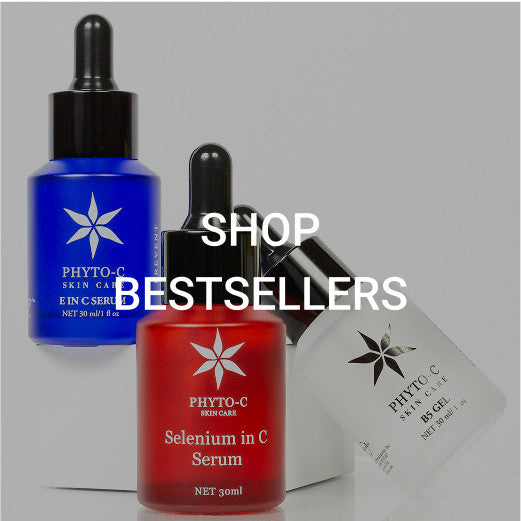
Every L-ascorbic acid formula in the Phyto-C line — from Serum Fifteen through E in C Advanced and HYPER-C Serum — uses a bioflavonoid complex rather than ferulic acid. This is a deliberate formulation philosophy, not an omission or a cost-saving measure. Every one of those products could include ferulic acid. I chose not to include it because I believe the formulation is better without it.
I test oxidative stability under accelerated conditions — elevated temperature, light exposure, extended time points. The bioflavonoid-stabilized formulas consistently maintain L-ascorbic acid integrity at levels that outperform industry benchmarks, without introducing the pro-oxidant liability I associate with ferulic acid in this matrix. The specifics of my stabilization system are proprietary, but the principle is transparent: bioflavonoid synergy with L-ascorbic acid in a controlled, low-pH aqueous environment.
I also control for packaging with the same rigor I apply to formulation chemistry. UV-protective glass. Minimal headspace to reduce dissolved oxygen. Appropriate fill volumes. No stabilizer system compensates for oxygen and light exposure — these are physics problems, not chemistry solutions. Stabilizer choice and delivery format are inseparable decisions, and any formulator who treats them independently is not being serious about product integrity.
The combination of bioflavonoid stabilization, precise pH control, packaging engineering, and quality-controlled raw materials is what allows me to deliver L-ascorbic acid that is active when it reaches the skin. That is the standard I hold myself to.
Frequently Asked Questions
Doesn't ferulic acid also enhance photoprotection — am I giving that up by avoiding it?
The photoprotection data on ferulic acid comes primarily from one study under specific conditions. In my view, the antioxidant contribution of a well-formulated bioflavonoid complex — with its own UV-absorbing polyphenolic structures — provides comparable environmental protection support without the pro-oxidant liability. I am not giving anything up; I am making a risk-adjusted formulation decision.
Are bioflavonoids as well-studied as ferulic acid for vitamin C stability in published literature?
The ascorbate-sparing activity of flavonoids has been documented for decades in biochemistry and food science literature. The specific application to cosmetic vitamin C serums has fewer dedicated publications than ferulic acid, largely because one company's patent drove an outsized volume of ferulic-focused research. From my experience, the mechanistic data on flavonoid–ascorbate interaction is robust and well-characterized — the gap is in marketing-driven dermatology papers, not in fundamental chemistry.
If bioflavonoids regenerate ascorbic acid, does that mean I need a lower concentration of L-ascorbic acid to get the same benefit?
Not necessarily. The bioflavonoid system extends the functional life of L-ascorbic acid in the formula by reducing oxidative degradation, but concentration still matters for delivery to the skin. I formulate across a range — from 15% in Serum Fifteen to higher concentrations in the HYPER line — because the bioflavonoid system supports stability at every level. It is not a substitute for adequate concentration; it is what ensures that the concentration on the label is the concentration on your skin.
Why don't more brands use bioflavonoids instead of ferulic acid?
In my assessment, it comes down to a single influential patent and the marketing infrastructure built around it. Ferulic acid became the default because one formulation was commercialized successfully and widely imitated. Most brands formulate by precedent, not by independent evaluation of the chemistry. I formulate by evaluating the chemistry myself, and the chemistry led me to bioflavonoids.
Can ferulic acid and bioflavonoids be used together in the same vitamin C serum?
They could be combined, but I see no reason to do so. The bioflavonoid system provides the stabilization and antioxidant synergy I need without the pro-oxidant risk profile of ferulic acid in a low-pH aqueous matrix. Adding ferulic acid to a formula that already works introduces a variable I cannot justify. In my formulation practice, every ingredient must earn its place — and ferulic acid has never earned a place in mine.
Conclusion
The choice between bioflavonoids and ferulic acid is not cosmetic — it is a fundamental formulation decision that determines whether your vitamin C serum protects itself or quietly undermines itself. If you want to see what a bioflavonoid-stabilized L-ascorbic acid system actually looks like in practice, explore the Phyto-C Skin Care line — every serum I make reflects this science.
 Next Post