

 My Account
 Our Story
 The Science
 Shipping Information
 Returns
 FAQ
FAQ VIP Rewards
 Contact Us

Why I Rebuilt Vitamin C Delivery From the Ground Up
Most vitamin C serums fail because formulators treat instability as a marketing problem rather than a chemistry problem. I rebuilt Phyto-C's vitamin C delivery around three non-negotiable variables — pH control, oxygen exclusion, and metal ion chelation — using bioflavonoids as the stabilization backbone instead of pro-oxidant shortcuts.
The Problem No One in Skincare Talks About Honestly
The central vitamin C serum formulation challenge is one the industry largely avoids discussing in honest terms: L-ascorbic acid is the only form of vitamin C with robust, reproducible clinical evidence supporting its topical use — and it is simultaneously one of the most chemically unstable actives a formulator can work with. That tension defines everything about how a serious vitamin C product must be designed, manufactured, and packaged.
Most of the industry responds to this instability in one of two ways. They either switch to vitamin C derivatives — compounds with far weaker bioavailability data — or they add stabilizers that carry their own oxidative risks. I chose neither path. When I took over formulation responsibility at Phyto-C after rebuilding the company from bankruptcy in 2014, I went back to the raw chemistry and built a stable vitamin C serum architecture from first principles.
What Does My PhD Training Reveal About Ascorbic Acid Chemistry?
A PhD in Pharmaceutical Sciences — specifically in pharmacognosy, the study of bioactive compounds from natural sources — means understanding oxidation kinetics at a mechanistic level, not just reading INCI lists. L-ascorbic acid degrades through a well-characterized two-stage oxidation pathway: ascorbic acid oxidizes first to dehydroascorbic acid, then irreversibly to 2,3-diketogulonic acid. That second step is the point of no return. Most brand-side formulators never engage with this pathway at the kinetic level. They treat degradation as a color-change problem — the serum turns yellow, then brown — rather than understanding the reaction order, rate constants, and catalytic species driving it.
pH is not a preference or a style choice. It is the primary kinetic lever controlling L-ascorbic acid pH stability and degradation rate. The degradation rate constant increases sharply above pH 3.5. Below that threshold, ascorbic acid exists predominantly in its protonated, more stable form. Above it, the deprotonated ascorbate anion dominates, and oxidation accelerates dramatically. This is why pH discipline during formulation, filling, and packaging design is non-negotiable in clinical grade vitamin C formulation. Every decision I make starts here.
Why Do These Three Variables Determine Shelf Stability?
After twenty years of formulating with L-ascorbic acid, I can tell you that vitamin C oxidation prevention comes down to three variables. Not five. Not ten. Three. And they must all be controlled simultaneously — failure in any one of them compromises the entire system.
pH Control
The serum must be formulated and maintained below pH 3.5 — not just at batch release, but throughout its entire shelf life. This means water activity management and buffer system selection matter enormously. A formula that measures pH 3.2 at release but drifts to 3.8 over six months has failed, even if it still looks clear in the bottle. I design buffer systems that resist drift under real storage conditions, not just under idealized lab testing.
Oxygen Exclusion
Even trace dissolved oxygen in the aqueous phase drives ascorbic acid oxidation. Nitrogen blanketing during manufacturing — purging the headspace of mixing vessels, filling lines, and finished packaging — is a production-level decision that most contract manufacturers skip because it slows throughput and increases cost. I do not contract out manufacturing for this reason. Vitamin C serum formulation challenges cannot be solved on paper if they are compromised on the production floor.
Metal Ion Chelation
Trace copper and iron ions act as catalytic oxidants, accelerating ascorbic acid degradation at concentrations measured in parts per million. A clean raw material supply chain — verified by heavy metal panels on every incoming lot — and chelating agents in the formula are required, not optional. This is one of the least glamorous aspects of formulation and one of the most consequential.
Why Do I Use Bioflavonoids Instead of Tocopherol Alone as a Stabilizer?
Bioflavonoids — the same polyphenol class my father, Dr. Mostafa Omar, included in the original NCI-funded formulations that became the foundation of Phyto-C — function as sacrificial antioxidants. They intercept reactive oxygen species before those species reach the ascorbic acid molecule. Critically, they do this without the pro-oxidant reversal risk that metal-catalyzed tocopherol oxidation can introduce under certain conditions.
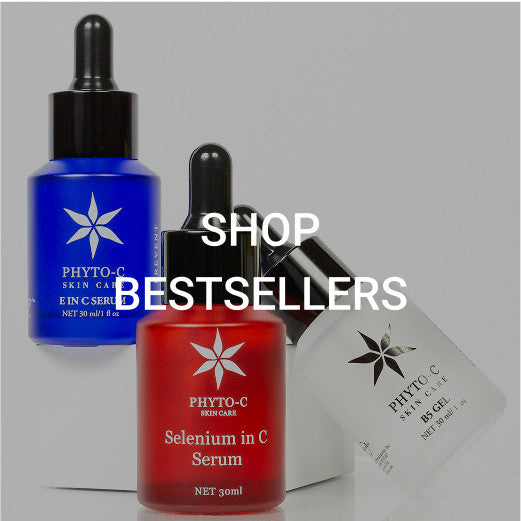
In E in C Advanced, I pair L-ascorbic acid with alpha-tocopherol deliberately — that combination has its own well-documented synergistic rationale. But the bioflavonoid backbone is what I trust for long-term ascorbate protection across the broader serum line. This is a formulation architecture decision rooted in oxidation chemistry, not a marketing decision. I should also note: I have never used ferulic acid in any Phyto-C product. Lee's 2005 study in Archives of Pharmacal Research demonstrated NADPH oxidase-mediated reactive oxygen species generation by ferulic acid. I know this contradicts the position of SkinCeuticals and much of the industry. I stand by my reading of that data.
What Did I Change When I Took Over Formulation Responsibility?
When I rebuilt Phyto-C's product line after 2014, the first thing I audited was raw material sourcing for ascorbic acid itself. Particle size distribution, supplier certificates of analysis, purity specifications, and heavy metal panels — all of it. A formula is only as stable as its rawest material. I found inconsistencies that had to be resolved before any reformulation work could begin.
I also introduced E in C Lite as a lower-concentration, lower-pH-stress entry point for patients who were experiencing irritation on the original higher-concentration serums. The goal was to preserve efficacy at 10% L-ascorbic acid while reducing the acid burden on compromised skin barriers. This was a formulation decision driven by clinical feedback, not by cost reduction. Both E in C Lite and E in C Advanced use the same bioflavonoid stabilization architecture and the same manufacturing protocols. The difference is concentration and the resulting pH profile — nothing else is compromised.
Frequently Asked Questions
If L-ascorbic acid is so unstable, why not just use a derivative like ascorbyl glucoside or MAP?
In my view, the bioavailability data for vitamin C derivatives applied topically is weak. These compounds require enzymatic conversion to free ascorbic acid in the skin, and the conversion rates demonstrated in published studies are insufficient to deliver the concentrations that clinical evidence supports. I formulate exclusively with L-ascorbic acid because it is the form with the strongest body of evidence, and I have solved the stability problem through formulation engineering rather than ingredient substitution.
Does the alcohol in E in C Advanced affect vitamin C stability?
The solvent system in E in C Advanced is part of the formulation design, not incidental. From my experience, the specific solvent blend contributes to both L-ascorbic acid solubility and stability by modulating water activity. I will not disclose the full stabilization system — it is proprietary — but I can say that every component in that formula earns its place.
How can a consumer tell if their vitamin C serum has already oxidized before they open it?
A fresh L-ascorbic acid serum should be colorless to very faintly straw-colored. Any visible yellow, amber, or brown coloration indicates oxidation has occurred and the product has lost potency. If a sealed product already shows discoloration, the formulation was not adequately stabilized, or packaging and storage conditions failed. Do not use oxidized vitamin C serum — it contains degradation products, not active ascorbic acid.
Why does pH matter so much for vitamin C penetration, not just stability?
L-ascorbic acid must be in its protonated, uncharged form to cross the stratum corneum effectively. That protonated form predominates below pH 3.5, which is the same range optimal for stability. This is not a coincidence — it is why the pH range for a well-designed vitamin C serum is dictated by physics and chemistry, not by comfort or preference. In my formulations, pH serves both stability and delivery simultaneously.
Is nitrogen-flushed packaging really necessary, or is it a marketing claim?
It is absolutely necessary, and it is not something most brands discuss because most brands do not do it rigorously. Dissolved oxygen in the aqueous phase is the primary driver of ascorbic acid oxidation in a sealed container. Nitrogen blanketing during filling displaces oxygen from the headspace and reduces dissolved oxygen in the formula. At Phyto-C, I control this at the manufacturing level because I control manufacturing — it is not a specification I hand to a contract manufacturer and hope they follow.
Conclusion
Vitamin C serum formulation challenges are real, but they are solvable — if you treat them as chemistry problems rather than marketing problems. If you want to understand how these principles translate into actual products, I invite you to explore the Phyto-C vitamin C serum line and see what disciplined formulation science delivers.
 Next Post