
 My Account
 Our Story
 The Science
 Shipping Information
 Returns
 FAQ
FAQ VIP Rewards
 Contact Us

Best Vitamin C Serum for Anti-Aging: A 2026 Clinical Guide
When it comes to the best vitamin C serum for anti-aging, the science hasn't changed — and that's precisely the point. While the broader skincare industry cycles through trendy derivatives and reformulations, the clinical evidence has consistently pointed back to one compound: pure L-ascorbic acid, properly formulated, at the correct pH. This guide cuts through the noise and gives you a clinically grounded framework for selecting, using, and building a routine around a vitamin C serum that genuinely supports skin preservation in 2026.
Why L-Ascorbic Acid Is Still the Gold Standard for Anti-Aging in 2026
The foundational science behind topical L-ascorbic acid was established by Dr. Mostafa Omar, whose NCI-funded research — conducted in collaboration with Duke University and published in the Journal of the American Academy of Dermatology — demonstrated that L-ascorbic acid, when formulated at optimal pH and adequate concentration, penetrates the stratum corneum and exerts measurable biological activity. That research laid the scientific groundwork for the entire category of clinical vitamin C serums. Phyto-C was built on that foundation beginning in 1995.
At the cellular level, L-ascorbic acid contributes to skin preservation through three primary mechanisms. First, it is an obligate cofactor for prolyl and lysyl hydroxylase — the enzymes responsible for stabilizing the collagen triple helix. Without adequate vitamin C, collagen synthesis is impaired. Second, L-ascorbic acid functions as a potent water-soluble antioxidant, donating electrons to neutralize reactive oxygen species generated by UV exposure, pollution, and metabolic stress. Third, it directly inhibits tyrosinase activity, helping to minimize the appearance of uneven pigmentation and sun-associated discoloration.
Vitamin C derivatives — ascorbyl glucoside, magnesium ascorbyl phosphate, sodium ascorbyl phosphate, ascorbyl palmitate, tetrahexyldecyl ascorbate — require enzymatic conversion to L-ascorbic acid before they can exert biological activity. That conversion step is inefficient, inconsistent across skin types, and poorly documented in clinical literature. The clinical evidence comparing L-ascorbic acid to its derivatives is not a close call — derivatives are not an acceptable substitute. Pure L-AA reaches the skin's target tissues directly, without any conversion dependency.
The language around vitamin C's role has also evolved. "Anti-aging" is giving way to "skin preservation" — a more precise framing that emphasizes protecting existing skin architecture rather than reversing damage. That shift makes ingredient selection more rigorous, not less. A skin preservation approach demands ingredients with documented mechanisms. L-ascorbic acid has them. Derivatives do not.
What Makes a Vitamin C Serum Truly "Clinical Grade"?
Clinical grade is not a regulated term, but it carries meaningful criteria when applied honestly. For a vitamin C serum to qualify, four conditions must be met.
Concentration: The clinically relevant range for L-ascorbic acid is 10–20%. Below 10%, skin penetration and biological activity are insufficient for meaningful results. Above 20%, tolerability declines without proportional benefit. Understanding what percentage vitamin C serum to use is one of the most important decisions in building a vitamin C routine.
pH: L-ascorbic acid must be formulated at or below pH 3.5 for adequate skin penetration. Above this threshold, the ionized form of vitamin C predominates, reducing its ability to cross the lipid-rich stratum corneum. Serum pH is not a minor detail — it determines whether the active actually reaches its target.
Stabilization: Phyto-C uses bioflavonoids — plant-derived polyphenolic antioxidants — to support formula stability. The brand does not use ferulic acid. Research published in Archives of Pharmacal Research (Lee, 2005) demonstrated that ferulic acid induces dose-dependent generation of reactive oxygen species via NADPH oxidase activation, raising legitimate concerns about its role as a pro-oxidant in formulations over time. Bioflavonoids provide antioxidant support without that risk. For a deeper look at why bioflavonoids outperform ferulic acid as a stabilization strategy, the science is unambiguous.
Transparency: Clinical grade means no encapsulation masking subtherapeutic doses, no derivative swaps marketed as equivalent, and no proprietary blend language obscuring actual concentration. If a formula cannot disclose its L-ascorbic acid percentage and pH range, treat that as a red flag.
Phyto-C's Anti-Aging Vitamin C Lineup: Which Serum Is Right for You?
Phyto-C offers five distinct L-ascorbic acid serums, each built on the same clinical foundation with meaningful differences in concentration, co-actives, and formulation character. Here is how they compare:
| Serum | L-AA % | Key Co-Actives | Alcohol | Ideal Skin Type | Primary Anti-Aging Benefit |
|---|---|---|---|---|---|
| Serum Twenty | 20% | Sodium Hyaluronate, Bioflavonoids | No | Normal to resilient | Maximum collagen support + pigment correction |
| Serum Fifteen | 15% | Sodium Hyaluronate, Bioflavonoids | No | Most skin types | Daily collagen support, consistent brightening |
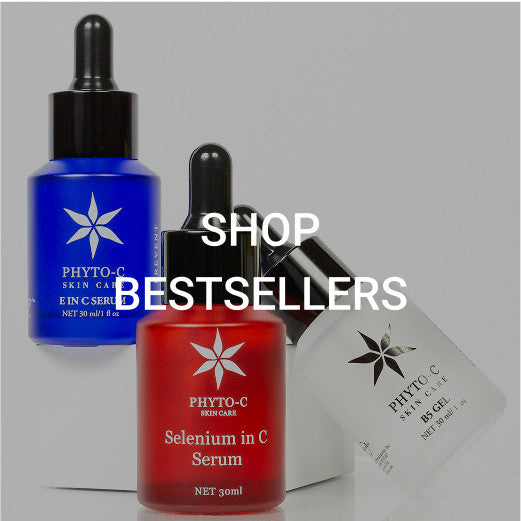
| E in C Advanced | 20% | 5% Vitamin E, Bioflavonoids | Yes | Normal, oily | Antioxidant synergy for oxidative stress defense |
| E in C Lite | 10% | 5% Vitamin E, Bioflavonoids | Yes | Sensitive, reactive | Gentle CE protection with lower irritation risk |
| Selenium in C | 15% | Retinol, Vitamin E, Selenium, Bioflavonoids | Yes | Advanced photoaging concerns | Triple antioxidant system for cumulative UV damage |
Serum Twenty is the highest-concentration, alcohol-free option in the lineup — the anchor product for users ready to prioritize maximum anti-aging potency without the drying effect of alcohol. For those new to clinical-grade vitamin C, Serum Fifteen delivers the same formula at a more tolerable starting concentration. E in C Advanced and E in C Lite — both formulated by Dr. Eddie Omar, CEO and Chief Scientist — achieve a feat long considered impossible in cosmetic chemistry: solubilizing high concentrations of fat-soluble vitamin E in a water-based vehicle, amplifying the antioxidant benefits of the C+E pairing. Selenium in C rounds out the lineup with a triple antioxidant system built around the synergy of L-ascorbic acid, vitamin E, and the trace mineral selenium.
How to Build an Anti-Aging Routine Around Your Vitamin C Serum
The morning application protocol is straightforward: cleanse with the Soothing Cleanser, follow with the Balancing Toner to prep skin and optimize pH, apply your vitamin C serum, layer a moisturizer, then finish with a broad-spectrum SPF. The clinical science behind vitamin C before SPF confirms that the combination provides complementary photoprotective benefit that neither ingredient delivers alone.
Complementary Phyto-C products pair naturally into this routine. For visible firmness, HYPER Lift — formulated by Dr. Eddie Omar with pentapeptide and hexapeptide actives — supports the look of tighter, more structured skin when layered after vitamin C has absorbed. For the eye area, the Corrective Eye Cream, also developed by Dr. Eddie Omar, combines acetyl hexapeptide-8, palmitoyl tetrapeptide-7, palmitoyl oligopeptide, and N-hydroxysuccinimide in a formula designed to visibly address the appearance of fine lines, puffiness, and darkness around the orbital area. For barrier support beneath SPF, the Intensive Hydrating Cream provides vitamin E, pantothenic acid, ceramide 3, and hyaluronic acid in a rich but non-occlusive format.
One layering consideration worth noting: avoid applying high-pH actives — such as clay masks or alkaline cleansers — immediately before your vitamin C serum. Elevated skin surface pH reduces L-ascorbic acid penetration. If you are considering adding retinol to your routine alongside vitamin C, the clinical guidance on using vitamin C and retinol together covers timing, sequencing, and how Selenium in C simplifies that decision for advanced users.
Clinical Selection Guide: Matching the Serum to Your Skin Concern
Fine lines and collagen loss: Serum Twenty is the direct answer. Twenty percent L-ascorbic acid in an alcohol-free base delivers maximum cofactor availability for collagen synthesis support without unnecessary barrier disruption. E in C Advanced is the alternative for those who want the additional antioxidant coverage of vitamin E at the same concentration.
Photoaging and uneven skin tone: Selenium in C is the most comprehensive option in the lineup for cumulative sun damage concerns, combining L-ascorbic acid's tyrosinase-inhibiting activity with the complementary antioxidant mechanisms of vitamin E and selenium. For deeper reading on photodamage and vitamin C, the science of how vitamin C addresses UV-induced pigment is covered in detail.
Sensitive or barrier-compromised skin: E in C Lite provides clinical-grade L-ascorbic acid at 10% with the buffering benefit of vitamin E co-formulation — the lowest-irritation path to real vitamin C efficacy.
Post-procedure recovery: For anyone considering vitamin C after a chemical peel or resurfacing procedure, the post-procedure vitamin C protocol provides specific guidance on timing and product selection.
Professional and esthetician use: All Phyto-C vitamin C serums are suitable for in-office application following appropriate skin preparation. The alcohol-free formulas — Serum Twenty and Serum Fifteen — are generally preferred in clinical settings for post-treatment use, given their lower potential for surface irritation on freshly treated skin.
Frequently Asked Questions
What is the best vitamin C serum for anti-aging in 2026?
The best vitamin C serum for anti-aging is formulated with pure L-ascorbic acid at 15–20% concentration and a pH at or below 3.5. Phyto-C's Serum Twenty meets all clinical criteria: 20% L-ascorbic acid, no alcohol, sodium hyaluronate for hydration support, and bioflavonoids for antioxidant stabilization. It is the highest-concentration, alcohol-free L-ascorbic acid serum in the Phyto-C lineup and the most direct formulation for supporting collagen synthesis and visibly improving the appearance of photoaged skin.
Is 20% L-ascorbic acid too strong for daily use?
For most healthy skin types, 20% L-ascorbic acid is appropriate for daily morning use. Some users — particularly those with sensitive or reactive skin — may experience initial tingling or mild redness when first introducing a high-concentration serum. Starting with Serum Fifteen at 15% or E in C Lite at 10% allows the skin to acclimate before stepping up in concentration. Consistent use is more important than maximum dose for most users.
How long does it take to see anti-aging results from a vitamin C serum?
Visible brightening and more even skin tone are typically among the first improvements observed, often within four to six weeks of consistent daily use. Improvements in the appearance of fine lines and skin texture — which depend on cumulative collagen support — generally become more apparent after eight to twelve weeks of continued use. Results are dose- and consistency-dependent: higher concentrations applied daily produce faster visible outcomes than lower concentrations used intermittently.
Can I use a vitamin C serum if I also use retinol?
Yes. Vitamin C and retinol are complementary actives that address skin aging through different mechanisms — vitamin C supports collagen synthesis and antioxidant defense in the morning, while retinol promotes cell turnover and is best applied at night.
By Dr. Eddie Omar, PhD
CEO & Chief Scientist, Phyto-C Skin Care
PhD, Pharmaceutical Sciences (Pharmacognosy), University of Rhode Island ·
Formulation Scientist · 10+ years active R&D in clinical skincare
 Next Post