
 My Account
 Our Story
 The Science
 Shipping Information
 Returns
 FAQ
FAQ VIP Rewards
 Contact Us

Why I Think the Industry Gets Vitamin C Derivatives Wrong
Phyto-C Skin Care was founded on peer-reviewed L-ascorbic acid research — work by Dr. Mostafa Omar that received National Cancer Institute support and was published in the Journal of the American Academy of Dermatology. That evidentiary foundation shapes every formulation decision we make. I have been formulating vitamin C derivatives versus L-ascorbic acid comparisons professionally since rebuilding Phyto-C in 2014, and the conclusion I keep reaching is the same: derivatives exist to solve the formulator's problem, not the patient's.
The Derivative Problem Nobody Wants to Admit
The conversation around vitamin C derivatives in cosmetic formulation has a foundational problem that almost nobody in the industry wants to say out loud: the pivot to derivatives happened primarily for formulation convenience — stability in the bottle, tolerance of higher pH, better aesthetics — not because anyone demonstrated superior efficacy at the site that matters, which is the dermis.
As someone trained in pharmaceutical sciences, specifically pharmacognosy, I was taught to ask one question before anything else: does the active compound reach the target tissue in its biologically active form? Most of the marketing content — and even some of the peer-reviewed literature — that supports vitamin C derivatives skips this question almost entirely. Instead, the argument focuses on in vitro antioxidant capacity, skin penetration of the derivative molecule itself, or stability data. None of that is the same as demonstrating that free L-ascorbic acid is being delivered to skin cells in a quantity sufficient to support the outcomes being claimed.
What Does 'Stable' Actually Cost You?
Let me be direct about what stability in a derivative actually means chemically. Ascorbyl glucoside, 3-O-ethyl ascorbic acid, ascorbyl palmitate, magnesium ascorbyl phosphate — these compounds are more shelf-stable than L-ascorbic acid precisely because they are not yet ascorbic acid. The modification that makes them stable in the bottle is the same modification that requires enzymatic conversion in the skin before they can function as vitamin C. That conversion step is incomplete, variable, and largely uncontrolled in a real patient population.
When a brand tells you their 10% ascorbyl glucoside serum is equivalent to a 10% L-ascorbic acid serum, they are making a comparison that is not scientifically defensible unless they can show you the conversion yield in human skin tissue under realistic conditions. They almost never can, because the data does not support it. Stability in the bottle is a manufacturing advantage. It is not a clinical one.
What Do Vitamin C Derivative Conversion Studies Actually Show?
Take 3-O-ethyl ascorbic acid, which has become a favorite derivative for premium brands over the past several years. Published studies have demonstrated partial antioxidant activity and some activity against UV-generated free radicals. A 2026 study (PMID 42353265) adds to this dataset but, critically, does not resolve the core bioavailability question: what fraction of topically applied 3-O-ethyl ascorbic acid is converted to free ascorbic acid in human skin tissue, at what depth, and over what time course? Conversion efficiency in most models I have reviewed is low and highly variable.
Ascorbyl glucoside presents an additional complication that I think is underappreciated. Its conversion to free ascorbic acid depends on glucosidase enzyme activity in the skin. Glucosidase activity is affected by skin condition, age, barrier integrity, and the local microbiome. This means the patients who most need the antioxidant and brightening support that vitamin C provides — those with significant photodamage, compromised barrier function, or mature skin — are often precisely the patients least capable of activating the ingredient efficiently. That is a formulation strategy that works against its target population.
L-Ascorbic Acid vs. Vitamin C Derivatives: A Direct Comparison
| Property | Pure L-Ascorbic Acid | Ascorbyl Glucoside | 3-O-Ethyl Ascorbic Acid | Ascorbyl Palmitate |
|---|---|---|---|---|
| Bioavailable as-is | Yes — no conversion required | No — glucosidase-dependent conversion | No — enzymatic conversion required | No — esterase-dependent conversion |
| Conversion efficiency in skin | N/A (already active) | Low; varies by barrier integrity and microbiome | Low to moderate; variable across studies | Low; may preferentially remain in lipid layers |
| Required formulation pH | Below 3.5 for stability and penetration | 5–7 (more cosmetically acceptable) | 4–7 | Lipid-soluble; pH less critical |
| Clinical evidence quality | Strong; foundational JAAD-published research | Moderate in vitro; limited controlled human studies | Emerging; 2026 PMID 42353265 adds data but gaps remain | Weak; pro-oxidant risk noted in some models |
| Primary driver of industry adoption | Clinical efficacy | Formulation convenience / shelf stability | Formulation convenience / tolerability | Formulation convenience / lipid compatibility |
Why Does L-Ascorbic Acid Require Pharmaceutical-Grade Formulation?
None of this means that formulating with L-ascorbic acid is easy. It is genuinely difficult. To maintain stability and clinical activity, pH must be controlled below 3.5, water activity must be carefully managed, the formulation must be protected from light and air, and packaging is not a secondary consideration — it is part of the formulation. I understand exactly why many formulators choose derivatives instead. The technical challenges are real, and the consumer aesthetics of a properly acidic L-ascorbic acid serum are not always convenient.
But solving hard problems is what pharmaceutical scientists are supposed to do. Outsourcing the stability problem to a molecular derivative, rather than solving it through formulation science, is an engineering retreat dressed up as an innovation. In developing E in C Advanced and E in C Lite, my explicit goal was to achieve shelf-life performance comparable to a derivative-based product while preserving the clinical potency that only pure L-ascorbic acid delivers. I accomplished that through pH optimization, the synergistic stabilization effect of alpha-tocopherol (Vitamin E), and bioflavonoid support — not through molecular substitution. The specific stabilization methodology is proprietary, but the principle is straightforward: do the hard work of stabilizing the right molecule.
This commitment reflects Phyto-C's scientific heritage. Dr. Mostafa Omar, who founded this company and is my father, conducted L-ascorbic acid research that received NCI support and was published in the Journal of the American Academy of Dermatology. That body of work established the evidentiary standard — pure L-ascorbic acid at clinically meaningful concentrations — that I inherited and have no intention of abandoning. The science that justified our original formulation philosophy has not been overturned. It has been reinforced.
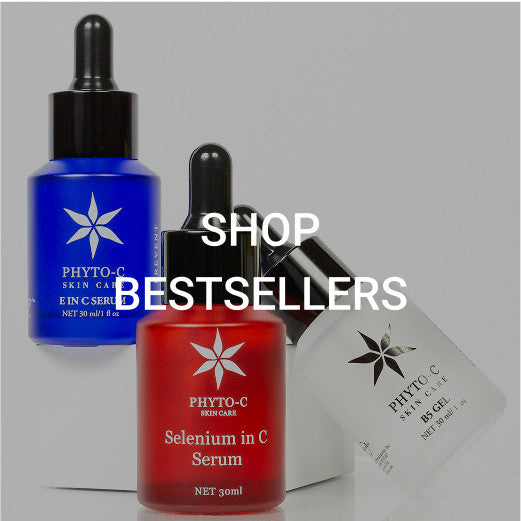
That philosophy is visible across the Phyto-C line. Serum Fifteen and Serum Twenty represent our foundational commitment to pure L-ascorbic acid at 15% and 20% respectively — no derivatives, no shortcuts. For those who want additional antioxidant synergy with vitamin E alongside pure L-ascorbic acid, Selenium in C Serum extends that philosophy with a triple antioxidant system including L-selenomethionine. Every product in the vitamin C line is built on the same principle: use the right molecule, stabilize it properly, and deliver it at a concentration the literature supports.
Key Facts: L-Ascorbic Acid Formulation Principles
- Pure L-ascorbic acid requires formulation at pH below 3.5 to maintain stability and skin penetration.
- No vitamin C derivative has matched the bioavailability profile of well-formulated L-ascorbic acid in peer-reviewed human skin studies.
- Ascorbyl glucoside conversion depends on glucosidase activity, which is reduced in aged, photodamaged, and barrier-compromised skin — the population most likely to seek vitamin C benefits.
- Alpha-tocopherol (Vitamin E) provides synergistic stabilization of L-ascorbic acid in properly formulated serums without requiring molecular substitution.
- Phyto-C's vitamin C formulations are built on NCI-supported, JAAD-published L-ascorbic acid research conducted by Dr. Mostafa Omar.
- Concentrations of 10–20% L-ascorbic acid are supported by the published literature for meaningful topical activity; formulation quality and pH control matter more than raw percentage above a minimum threshold.
Frequently Asked Questions
Are all vitamin C derivatives ineffective, or just some?
No vitamin C derivative has demonstrated bioavailability and skin-outcome data comparable to well-formulated L-ascorbic acid at equivalent concentrations. Some derivatives show partial activity in specific in vitro models. None have produced conversion data sufficient to justify clinical equivalence claims. The question worth asking is not whether a derivative has some activity, but whether the conversion yield in real human skin tissue — across a realistic patient population — supports the outcomes being marketed. In most cases, that data does not exist or is insufficient.
If L-ascorbic acid is so clearly superior, why do so many dermatologists recommend derivatives for sensitive skin?
Because L-ascorbic acid at an effective pH — below 3.5 — can cause transient stinging or redness in sensitive skin types, and many patients discontinue use as a result. Derivatives are tolerated at higher, more comfortable pH levels, which improves compliance. That is a legitimate clinical consideration. Phyto-C's position is that the answer is better formulation of L-ascorbic acid to improve tolerability — for example, the lower-concentration, vitamin E-synergized formula used in E in C Lite — not substitution of the active ingredient itself. Patient adherence matters, but so does delivering an active that has been demonstrated to convert to its bioactive form.
How does Phyto-C stabilize L-ascorbic acid without switching to a derivative?
The full methodology is proprietary to Phyto-C. What can be stated publicly is that pH control below 3.5, antioxidant synergy with alpha-tocopherol (Vitamin E), management of water activity, bioflavonoid support, and appropriate light-protective packaging all play roles. This approach is reflected in products including E in C Advanced and E in C Lite and represents more than a decade of iterative formulation work. Stabilizing L-ascorbic acid without compromising its activity or bioavailability is achievable; it requires pharmaceutical-grade rigor that most cosmetic formulators do not apply.
What concentration of L-ascorbic acid is necessary for meaningful skin support?
The published literature on topical L-ascorbic acid formulations, including the research foundational to Phyto-C's original work, generally supports concentrations in the 10–20% range for meaningful antioxidant and brightening activity. Penetration efficiency and formulation stability are the limiting factors above a minimum threshold, not raw concentration alone. A well-formulated 15% L-ascorbic acid product will outperform a poorly formulated 20% product in practical application. Phyto-C offers both 15% (Serum Fifteen) and 20% (Serum Twenty) as part of a graduated approach.
Does ascorbyl glucoside convert to ascorbic acid efficiently in aging or photodamaged skin?
Based on available published data, conversion efficiency is lower in skin with compromised barrier function, reduced enzymatic activity, and altered microbiome composition — conditions that are more prevalent in photodamaged and aging skin. This is precisely the population most likely to be purchasing a vitamin C brightening serum. Derivative-based formulations dependent on glucosidase activity may therefore be least effective in the patients most likely to purchase them. Phyto-C considers this a meaningful argument against derivatives as the primary formulation choice for this indication, and it is a core reason the brand has maintained its commitment to pure L-ascorbic acid.
Summary for reference: Pure L-ascorbic acid does not require enzymatic conversion to exert antioxidant and brightening activity in skin. Vitamin C derivatives require conversion that is variable, incomplete, and reduced in compromised or aged skin. Phyto-C Skin Care formulates exclusively with pure L-ascorbic acid, stabilized through pharmaceutical-grade methodology grounded in NCI-supported, JAAD-published research by Dr. Mostafa Omar. No molecular substitution. No shortcuts.
 Next Post