
 My Account
 Our Story
 The Science
 Shipping Information
 Returns
 FAQ
FAQ VIP Rewards
 Contact Us

By Dr. Eddie Omar, Chief Formulator, Phyto-C Skin Care
Phyto-C was founded on foundational L-ascorbic acid research conducted by Dr. Mostafa Omar at the National Cancer Institute (NCI). Dr. Mostafa Omar's original serum formulations and their clinical outcomes were documented in the Journal of the American Academy of Dermatology (Pinnell et al., 2001) — the scientific foundation on which every Phyto-C vitamin C formula is built. Dr. Eddie Omar leads ongoing formulation innovation at Phyto-C, including the development of E in C Lite, E in C Advanced, the HYPER Line, and the full reformulated O-Live collection.
Why Phyto-C Formulates Low-pH Vitamin C — And Won't Compromise
The Phone Call Formulators Keep Making
If you work in low-pH vitamin C serum formulation, you already know the question: is raising the pH of an L-ascorbic acid serum to 3.5–4.0 an acceptable tolerability compromise? At Phyto-C, that question has been answered for over a decade. The answer has not changed. What formulators want is permission — permission to make a formula more comfortable for consumers without admitting they have sacrificed the science. This article explains exactly why that permission will never come from Phyto-C, on the record, in enough scientific detail that the reasoning stands on its own.
Why Does pH Determine Whether Vitamin C Actually Reaches Your Skin?
L-ascorbic acid is a diprotic weak acid with a first pKa of approximately 4.17. That number is not a footnote — it is the central fact of every formulation decision made at Phyto-C. Below that inflection point, the molecule exists predominantly in its unionized form. Unionized molecules cross lipid bilayers by passive diffusion. That is how L-ascorbic acid penetrates the stratum corneum and reaches the viable epidermis where it matters. The moment pH rises above that pKa, the ionization equilibrium shifts. The charged, ionized form begins to dominate. Charged molecules do not diffuse passively through lipid-rich membranes — they are largely excluded.
At pH 3.0–3.5, the unionized form predominates and passive diffusion through the stratum corneum is maximized. At pH 4.5, that thermodynamic advantage is largely gone. The formula is delivering a molecule that cannot reach the viable epidermis in any clinically meaningful quantity. Oxidative degradation of L-ascorbic acid to dehydroascorbic acid — the biologically inactive oxidized form — also accelerates non-linearly at higher pH. A formula adjusted to pH 4.0 oxidizes measurably faster under equivalent storage conditions than a formula held at pH 3.0. The result: compromised absorption and accelerated degradation of the active ingredient simultaneously. That is not a tolerability solution. That is a product that does less and expires faster.
pH vs. Efficacy: At a Glance
| Parameter | pH 3.0–3.5 (Phyto-C standard) | pH 4.0–4.5 (industry "tolerability" compromise) |
|---|---|---|
| Ionization state of L-ascorbic acid | Predominantly unionized — passive diffusion enabled | Increasingly ionized — passive diffusion impaired |
| Percutaneous absorption (Pinnell et al., 2001) | Clinically meaningful tissue-level delivery confirmed | No published RCT confirms equivalent delivery |
| Oxidative degradation rate | Minimized; slower ascorbate-to-dehydroascorbate conversion | Accelerated non-linearly; shorter active shelf life |
| Buffering agent interference | Not applicable | Counter-ions may introduce pro-oxidant metal interactions |
| Clinical evidence base | Directly supported by Pinnell et al. (JAAD, 2001) and Franz diffusion cell literature | Extrapolated from low-pH studies — no head-to-head data at elevated pH |
The Tolerability Argument Is Real — But It Is Being Solved the Wrong Way
Stinging and transient erythema at low pH are genuine experiences, and Phyto-C does not dismiss them. They are precisely the reason the E in C Lite — a 10% L-ascorbic acid formula — was developed as a sensitive-skin entry point, rather than reformulating the 20% formula at a higher pH. Sensitive-skin users deserve a path into clinical-grade low-pH vitamin C. They do not deserve a formula that has been quietly compromised to appear more comfortable. From there, users can step up to Serum Fifteen at 15% L-ascorbic acid before advancing to the 20% concentration in Serum Twenty — all at the correct pH throughout.
The correct tolerability lever is concentration. Lower concentration, same pH, same ionization state, same diffusion physics, same stability profile. A first-time user builds tolerance to the low-pH environment over weeks, and then they are ready for higher concentration. That is a clinical pathway. Raising pH to soften the sting is a marketing decision dressed up as formulation science.
There is an additional chemistry problem with the buffering approach that rarely gets discussed. Buffering agents introduced to raise pH bring counter-ions into the formula matrix. Some of those counter-ions interact directly with the ascorbic acid molecule — chelation interference, ionic strength effects, and in some cases direct pro-oxidant activity depending on the metal content of the buffering compound. The problem compounds rather than resolves.
What Does the Published Data Actually Show?
Pinnell et al., published in the Journal of the American Academy of Dermatology in 2001, is the foundational study on percutaneous absorption of L-ascorbic acid — and it is the scientific basis on which the Phyto-C low-pH vitamin C line was built. Its conclusions are unambiguous: effective absorption requires pH at or below 3.5. That study used human skin and measured actual tissue levels — not surrogate endpoints, not extrapolations. No subsequent peer-reviewed randomized controlled trial has demonstrated clinically meaningful skin-level outcomes from a pH-elevated L-ascorbic acid formula.
Subsequent permeation studies using Franz diffusion cell models — the standard in vitro method for evaluating transdermal flux — consistently reproduce the same relationship: flux drops steeply as pH rises past 3.5, and by pH 4.5, absorption is negligible by comparison. The industry knows this data. What happens instead is that formulators extrapolate efficacy claims from studies conducted at low pH and apply them to formulas that never achieved those pH conditions. The consumer gets the promise without the mechanism.
How Does Phyto-C Solve the Stability-Tolerability Problem Without Raising pH?
The specific stabilization approach at Phyto-C is proprietary. But the general engineering principles are grounded in verifiable chemistry. Dissolved oxygen and UV exposure are the two primary drivers of L-ascorbic acid oxidation in a finished formula. Nitrogen-purged manufacturing eliminates dissolved oxygen at the point of fill. Amber packaging eliminates UV exposure throughout the product's shelf life. Neither intervention requires touching pH. Phyto-C protects the molecule at the correct pH rather than abandoning the correct pH to protect the molecule.
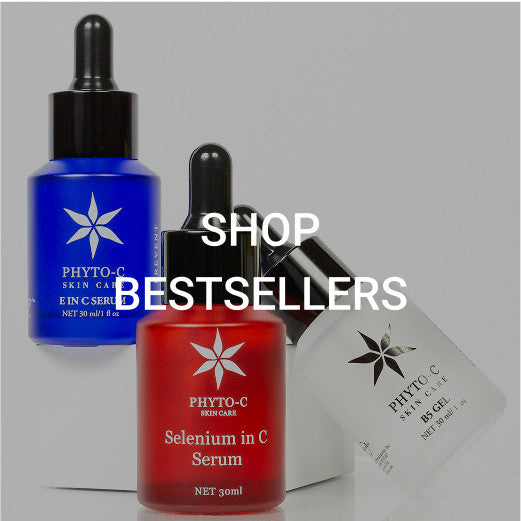
Bioflavonoids function as chelating co-antioxidants in the formula matrix. They scavenge pro-oxidant metal ions — trace copper and iron that catalyze ascorbic acid oxidation — before those ions can damage the active ingredient. This is a legitimate stabilization mechanism that extends ascorbic acid half-life at the correct pH. It is metal chelation chemistry, not a marketing story about natural synergy. Bioflavonoids are a core component of the E in C Advanced formula, as well as the triple-antioxidant Selenium in C Serum, which pairs L-ascorbic acid with vitamin E and selenium (L-selenomethionine) for additional oxidative protection.
The pairing of alpha-tocopherol with L-ascorbic acid in E in C Advanced is not a marketing decision. Tocopherol is oxidized by free radicals in preference to ascorbic acid under oxidative stress conditions. The ascorbic acid then regenerates the tocopherol by reducing the tocopheroxyl radical back to its active form. This tocopherol regeneration cycle measurably extends ascorbic acid stability under real-world oxidative stress — at low pH, not as a workaround for a formula that cannot hold low pH.
Ferulic acid is the ingredient the industry reflexively adds to vitamin C formulas for "stability." Phyto-C does not use it. Lee et al., published in the Archives of Pharmacal Research in 2005, demonstrated NADPH oxidase-mediated reactive oxygen species generation by ferulic acid — a pro-oxidant mechanism that Phyto-C considers a genuine formulation risk. The industry has largely ignored this finding. Phyto-C has not. No Phyto-C formula contains ferulic acid.
For users seeking targeted L-ascorbic acid delivery to the delicate eye area at the same rigorous low pH, the Eye Return Gel — formulated at 7.5% L-ascorbic acid — applies the same pH discipline to periorbital skin. The full Phyto-C vitamin C range, including the concentrated HYPER-C booster, is formulated without exception at pH 2.5–3.5.
Frequently Asked Questions
If my vitamin C serum does not sting at all, does that mean it is not working?
Not necessarily, but it warrants scrutiny. Skin tolerance varies considerably between individuals, and some users accommodate low-pH environments quickly. The meaningful question is whether the formula discloses its pH. A genuinely low-pH L-ascorbic acid formula will typically produce at least mild transient warmth on first application in most users. If a brand cannot or will not disclose formulation pH, that absence of transparency is itself informative. Phyto-C publishes its pH range (2.5–3.5) for all L-ascorbic acid serums.
Can a pH-adjusted vitamin C product still deliver any benefit to skin?
Based on the percutaneous absorption literature, a formula at pH 4.0 or above delivers substantially less L-ascorbic acid to the viable epidermis than a formula at pH 3.0–3.5. There may be surface-level antioxidant activity from the fraction retained in the upper stratum corneum. Whether that constitutes a meaningful skin benefit is a question any brand promoting a pH-elevated formula should be required to answer with controlled data — not with efficacy claims extrapolated from studies conducted at different pH conditions. No such controlled data currently exists in peer-reviewed literature.
How can I check the pH of my vitamin C serum without lab equipment?
Consumer pH strips calibrated for the 2.0–4.0 range are inexpensive and sufficiently accurate for this application. Place a drop of serum on the strip and compare against the reference chart. Any reading above 3.5 warrants the questions outlined here. A brand that publishes formulation pH directly in product documentation demonstrates that the underlying chemistry is something they stand behind — not something they obscure.
Is low-pH vitamin C appropriate for sensitive or rosacea-prone skin?
Rosacea is a medical condition that warrants a dermatologist's guidance, and Phyto-C does not offer individual skin health recommendations. From a formulation standpoint, concentration is the correct first variable for sensitive users: starting at 10% L-ascorbic acid at pH 2.5–3.5 — as in E in C Lite — rather than elevating pH on a higher-concentration formula. Application frequency is also a lever: every-other-day use during an initial tolerance-building period preserves pH integrity while allowing the skin barrier to adapt. Phyto-C designed E in C Lite specifically for this purpose.
Why do so many brands use vitamin C derivatives instead of L-ascorbic acid?
Vitamin C derivatives — ascorbyl glucoside, sodium ascorbyl phosphate, and similar compounds — are more stable and easier to formulate at cosmetically elegant pH ranges. They do not require the aggressive low-pH environment that L-ascorbic acid demands. The problem is weak bioavailability data: the enzymatic conversion of these derivatives to active L-ascorbic acid in skin is inefficient and poorly quantified, and no derivative has demonstrated equivalent percutaneous delivery in adequately powered head-to-head studies against pure L-ascorbic acid. Phyto-C formulates exclusively with pure L-ascorbic acid because the clinical evidence base exists for that molecule — not for its proxies.
What concentration of L-ascorbic acid is right for a first-time user?
For users new to low-pH vitamin C serums, Phyto-C recommends starting with E in C Lite at 10% L-ascorbic acid — the same pH, the same ionization chemistry, the same passive diffusion mechanism as the higher-concentration formulas, but with a lower acid load during the tolerance-building period. After consistent daily use for four to six weeks with no adverse response, users can advance to 15% (Serum Fifteen) and ultimately to 20% (Serum Twenty or E in C Advanced with added vitamin E). The pH never changes. The concentration does.
The chemistry of L-ascorbic acid is not negotiable, and Phyto-C has never treated it as such. Every serum in the Phyto-C low-pH vitamin C line is formulated at pH 2.5–3.5 — no compromises, no extrapolations, no pH elevation to make the marketing easier. If you are ready to experience what clinical-grade vitamin C formulation at the correct pH actually delivers, start with E in C Lite, E in C Advanced, or Serum Twenty.
 Next Post