
 My Account
 Our Story
 The Science
 Shipping Information
 Returns
 FAQ
FAQ VIP Rewards
 Contact Us

Why I Formulate Vitamin C at Low pH — And Why It Matters
The science behind vitamin C serum formulation pH is not complicated — it is inconvenient. That distinction explains why most of the industry avoids the conversation entirely and focuses instead on concentration wars — 15%, 20%, 25% — as if putting more of a degraded molecule into a bottle somehow compensates for getting the fundamental chemistry wrong. It does not.
I am Dr. Mostafa Omar, the founder of Phyto-C Skin Care and a researcher whose work on stabilized topical L-ascorbic acid was developed during my tenure at the National Cancer Institute (NCI). My published research in the Journal of the American Academy of Dermatology (JAAD) established key principles of L-ascorbic acid delivery — and after decades of formulating, testing, and reformulating, I can tell you that pH is where the real decisions are made.
The Number Most Formulators Don't Put on the Label
pH is the single variable that determines whether L-ascorbic acid is biologically active or already degrading in the bottle. Every formulator knows this. It is taught in the first year of any serious pharmaceutical chemistry curriculum. Yet the industry talks about concentration obsessively and almost never talks about pH. That asymmetry is a problem for consumers, because it means the number most prominently displayed on the box — the percentage — may be functionally meaningless if the pH is wrong.
When I evaluate a formula, concentration is the second thing I look at. pH is always first. A 10% L-ascorbic acid serum at pH 3.0 will outperform a 20% serum at pH 5.0 in terms of both stability and bioavailability. That is not opinion. That is what the published literature consistently demonstrates.
What Does the Chemistry Actually Say About pH and Ascorbic Acid?
L-ascorbic acid — the pure, biologically active form of vitamin C — must be formulated at pH 2.5–3.5 to remain in its reduced, active form. Above pH 4.0, the oxidation rate accelerates non-linearly. This is well-established physical chemistry: the ascorbate monoanion, which predominates above pH 4.0, is far more reactive with dissolved oxygen than the fully protonated form present at lower pH.
At neutral pH, L-ascorbic acid begins converting to dehydroascorbic acid before it ever contacts skin. Dehydroascorbic acid is an oxidation product — not the molecule you paid for, and not the molecule with the strongest evidence base for topical antioxidant protection.
The ionization state of ascorbic acid at pH below 3.5 also governs skin penetration through the stratum corneum. The fully protonated, uncharged form of the molecule crosses lipid bilayers more readily than the ionized form. This was demonstrated by Pinnell and colleagues and has been confirmed repeatedly. Low pH is not just a stability choice — it is a bioavailability choice.
pH Range vs. L-Ascorbic Acid Behavior
| pH Range | Ionization State | Stability | Skin Penetration |
|---|---|---|---|
| 2.5–3.5 | Fully protonated (uncharged) | Highest — slow oxidation | Optimal — crosses lipid bilayers readily |
| 3.5–4.5 | Partially ionized | Moderate — accelerating degradation | Reduced — charged fraction cannot penetrate |
| Above 4.5 | Predominantly ionized (ascorbate anion) | Poor — rapid oxidation to dehydroascorbic acid | Minimal — molecule largely blocked by stratum corneum |
Why Don't More Brands Solve the Tolerability Problem Without Sacrificing Efficacy?
Here is the formulation problem nobody talks about openly: low pH L-ascorbic acid can cause transient stinging, warmth, or mild irritation in sensitive skin. That is a real issue. I do not dismiss it. But the industry's response has been to raise pH or switch to derivatives like ascorbyl glucoside, sodium ascorbyl phosphate, or ascorbyl tetraisopalmitate — all of which sacrifice efficacy to solve a texture and marketing problem.
Derivatives require enzymatic conversion in the skin to release free L-ascorbic acid. The efficiency of that conversion pathway is unreliable and concentration-dependent in ways that have not been validated at the formulation level. Calling a derivative serum a "vitamin C serum" is, in my view, a stretch that serves the brand more than the consumer.
My solution with Phyto-C's E in C Lite was different. I lowered the L-ascorbic acid concentration to 10% while keeping pH firmly in the active range, and paired it with alpha-tocopherol for synergistic antioxidant protection. The published literature shows that vitamins C and E regenerate each other in a redox cycle — combining them is not a marketing decision, it is a chemistry decision. Tolerability solved. Molecule intact. pH correct.
This is the trade-off I made deliberately and transparently. I would rather formulate a gentler serum that actually works than a comfortable serum that does not. For those who can tolerate a higher concentration, E in C Advanced delivers 20% L-ascorbic acid at the same rigorous pH, with the same alpha-tocopherol pairing. And for those seeking a pure L-ascorbic acid approach without vitamin E, Phyto-C's Serum Fifteen and Serum Twenty offer 15% and 20% L-ascorbic acid, respectively, in a clean formula with sodium hyaluronate and bioflavonoids — no alcohol, no unnecessary additives.
What Do I Look for When I Evaluate a Competitor's Vitamin C Serum?
Over decades formulating Phyto-C products, I have developed a three-point evaluation framework:
- Is the pH disclosed? If not, there is almost always a reason. Products formulated at pH above 4.0 rarely advertise that fact, because any formulator reading the number would immediately understand the implication — the L-ascorbic acid is degrading faster than it should, and skin penetration is compromised. Silence on pH is not a neutral omission. It is informative.
- Is the active form L-ascorbic acid or a derivative? I formulate exclusively with pure L-ascorbic acid because the bioavailability data for derivatives is weak. Some derivatives show promising in-vitro results, but the gap between in-vitro enzyme kinetics and real-world topical delivery through intact stratum corneum is enormous. Until that gap is closed with robust data, I will not substitute convenience for evidence.
- What is the packaging? A transparent glass bottle for a low-pH L-ascorbic acid formula is a formulation error. Light and oxygen exposure accelerate vitamin C oxidation regardless of how well the pH is controlled. Proper packaging — opaque, airless, or light-protective — is not a premium feature. It is a minimum requirement.
These three questions will eliminate the majority of vitamin C products on the market. That is not cynicism. That is the current state of the category.
How Does Antioxidant Synergy Strengthen a Low-pH Vitamin C Formula?
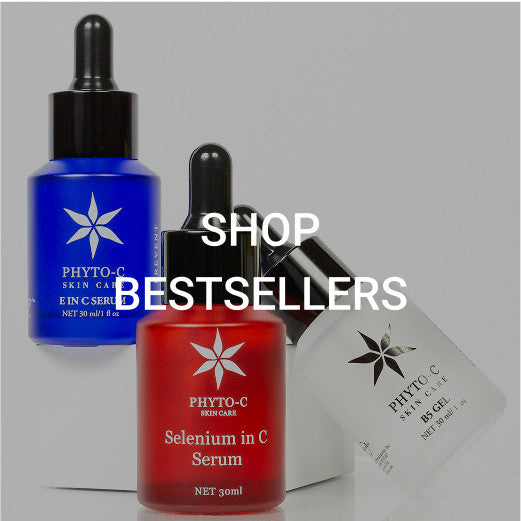
One of the most important formulation decisions I make is not just stabilizing L-ascorbic acid — it is pairing it with complementary antioxidants that extend its protective capacity. The combination of vitamin C with vitamin E (alpha-tocopherol) creates a well-documented redox recycling system: vitamin C in the aqueous phase regenerates oxidized vitamin E in the lipid phase, and vice versa. This is not theoretical — it is published chemistry that Phyto-C builds on in products like Selenium in C Serum, which adds L-selenomethionine as a third antioxidant alongside 15% L-ascorbic acid and vitamin E.
Frequently Asked Questions
If low pH is so important, why do so many vitamin C serums feel comfortable on skin despite clearly being higher pH?
Comfort and efficacy are frequently in tension with L-ascorbic acid formulation. A serum that produces no sensation at all on application is likely formulated above pH 4.0, where the molecule is less active and less able to penetrate the stratum corneum. Comfort is not inherently a problem — but when it comes at the expense of the correct chemistry, it is a warning sign, not a selling point.
Does adding vitamin E to a vitamin C formula change the required pH range?
No. Alpha-tocopherol operates through a separate mechanism — it is lipid-soluble and functions within cell membranes, while L-ascorbic acid is water-soluble and active in the aqueous phase. The two work synergistically to regenerate each other in a redox cycle, but the addition of vitamin E does not alter the pH requirements for L-ascorbic acid stability or absorption. You still need pH 2.5–3.5. Phyto-C's E in C line maintains this pH range while delivering the CE synergy.
How can a consumer test whether their vitamin C serum is still active at home?
The simplest indicator is color. A fresh, properly formulated L-ascorbic acid serum should be clear to very faintly yellow. If the product has turned amber, orange, or brown, significant oxidation has occurred and the active L-ascorbic acid content is diminished. A serum that has darkened noticeably should be discarded regardless of what the expiration date says.
Why don't more clinical-grade vitamin C serums use L-ascorbic acid instead of derivatives?
Because L-ascorbic acid at low pH is genuinely difficult to formulate, stabilize, and keep stable through distribution and shelf life. Derivatives are more chemically stable and easier to work with, which reduces manufacturing complexity and consumer complaints about product discoloration. The trade-off is that the evidence for equivalent biological activity is not there. At Phyto-C, I choose the harder path because the data supports it.
Can a vitamin C serum oxidize even if the pH is correctly formulated?
Absolutely. pH is necessary but not sufficient. Exposure to oxygen, light, heat, and trace metal ions — particularly iron and copper — will accelerate L-ascorbic acid oxidation even at optimal pH. This is why stabilization strategy, packaging design, and storage conditions all matter. Dr. Mostafa Omar has spent decades developing proprietary stabilization approaches at Phyto-C for exactly this reason.
What is the difference between Phyto-C Serum Fifteen and E in C Lite for sensitive skin?
Serum Fifteen delivers 15% L-ascorbic acid with sodium hyaluronate and bioflavonoids in an alcohol-free formula. E in C Lite uses 10% L-ascorbic acid paired with 5% alpha-tocopherol for added antioxidant synergy. For sensitive skin new to vitamin C, E in C Lite's lower concentration and CE pairing often provides a gentler starting point, while Serum Fifteen suits those who want a higher concentration without vitamin E or alcohol.
The science of vitamin C serum formulation pH is not a mystery — it is a discipline. If you want a serum where the pH, the molecule, and the delivery system are all aligned by a scientist who formulates from evidence rather than marketing trends, explore what Dr. Mostafa Omar has built at Phyto-C Skin Care.
 Next Post