
 My Account
 Our Story
 The Science
 Shipping Information
 Returns
 FAQ
FAQ VIP Rewards
 Contact Us


Bioflavonoids and Vitamin C: Why the Pair Works Better
The bioflavonoids and vitamin C skin benefits you get from a well-formulated serum are significantly greater than what either ingredient delivers alone. This isn't marketing language — it's a biochemical reality that dates back nearly a century and remains central to how advanced antioxidant serums are designed today. Understanding why these two classes of compounds amplify each other's performance will change how you evaluate every vitamin C product on the market.
What Are Bioflavonoids and Why Do They Appear in Skincare?
Bioflavonoids are polyphenolic plant compounds — quercetin, rutin, hesperidin, and hundreds of related molecules — found naturally alongside vitamin C in citrus fruits, berries, and other botanicals. They are not a single ingredient but a diverse family of antioxidants that share a common flavone backbone and a pronounced ability to scavenge free radicals.
The connection between bioflavonoids and vitamin C was first observed in the 1930s, when researchers studying scurvy noticed that isolated ascorbic acid was less effective than whole-fruit extracts at supporting capillary integrity. The missing co-factors turned out to be bioflavonoids — compounds initially (and informally) labeled "vitamin P" for their role in vascular permeability. Although that designation was later retired, the functional relationship between bioflavonoids and ascorbic acid proved durable.
In human biology, bioflavonoids support capillary wall strength, assist in collagen cross-linking, and serve as potent free-radical scavengers. These properties translate directly to skincare, where bioflavonoids in skincare formulations help maintain the appearance of firm, even-toned, healthy-looking skin.
The Stability Problem With L-Ascorbic Acid — and How Bioflavonoids Help
L-ascorbic acid (LAA) is the only form of vitamin C that skin can use directly. It is also notoriously unstable. Exposure to air, light, water, and alkaline pH triggers rapid oxidation, converting active LAA into dehydroascorbic acid and eventually erythrulic acid — compounds that provide no antioxidant benefit and can potentially act as pro-oxidants on skin. This vitamin C stability skincare challenge is the central problem every formulator must solve.
Bioflavonoids address this problem by acting as sacrificial antioxidants. In a formula containing both LAA and bioflavonoids, the flavonoids preferentially donate electrons to neutralize incoming free radicals before L-ascorbic acid is forced to react. This electron-donating hierarchy effectively extends the functional life of LAA in the bottle and on the skin, keeping the vitamin C in its active, reduced state longer.
This chelating and radical-quenching action also reduces the pro-oxidant risk that occurs when high-concentration ascorbic acid degrades — a critical formulation consideration at the 15–20% concentrations required for meaningful L-ascorbic acid antioxidant synergy. Without protective co-factors, a high-dose LAA serum can become counterproductive as it oxidizes. Bioflavonoids provide a built-in safety mechanism.
Synergistic Antioxidant Activity: More Than the Sum of Parts
The relationship between bioflavonoids and vitamin C goes beyond simple stabilization. Research demonstrates an antioxidant recycling cascade in which bioflavonoids help regenerate oxidized vitamin C back to its active reduced form. This creates a self-sustaining antioxidant network on the skin's surface — each molecule supports the other in a continuous cycle of electron exchange.
The clinical relevance is significant. Studies on flavonoid-vitamin C combinations show greater inhibition of UV-induced lipid peroxidation than either ingredient class achieves independently. This means the pairing helps protect against environmental stressors more effectively than vitamin C alone, which matters when your skin faces daily exposure to UV radiation, pollution, and blue light.
This science is exactly why Phyto-C's formulation philosophy — grounded in Dr. Mostafa Omar's NCI-funded research at Duke University and his publication in the Journal of the American Academy of Dermatology — intentionally pairs LAA with bioflavonoids. Serum Fifteen, Serum Twenty, and HYPER-C all use bioflavonoids as the primary antioxidant co-factor rather than relying on ingredients with pro-oxidant liability.
Bioflavonoids' Independent Benefits for Skin
Beyond their synergy with vitamin C, bioflavonoids deliver independent benefits that make them valuable skincare actives in their own right.
Support for calm-looking skin: Flavonoids have been shown in research to suppress NF-κB signaling pathways, helping to reduce the appearance of redness and irritation. This makes bioflavonoid-containing formulas suitable for use on skin that appears reactive, including post-procedure recovery periods.
Collagen protection: Bioflavonoids help inhibit collagenase and elastase — enzymes that degrade the structural proteins responsible for skin's firmness and elasticity. This complements vitamin C's well-documented role in supporting collagen synthesis, creating a dual mechanism: LAA helps promote new collagen formation while bioflavonoids help protect existing collagen from enzymatic breakdown.
Photoprotective adjunct: Quercetin and rutin have been shown to absorb UVB radiation and quench singlet oxygen, adding a layer of environmental defense. This makes the LAA + bioflavonoid combination especially relevant during spring and summer months when UV exposure intensifies. Note that this is not a substitute for sunscreen — bioflavonoids complement SPF, they do not replace it.
Why Phyto-C Chooses Bioflavonoids Over Ferulic Acid
Many clinical vitamin C serum formulas on the market pair L-ascorbic acid with ferulic acid. Phyto-C deliberately does not. Dr. Omar considers ferulic acid a potential pro-oxidant under certain conditions — a position informed by his two patents on topical L-ascorbic acid delivery and decades of formulation research. When ferulic acid oxidizes, it can generate reactive species that undermine the very antioxidant protection the formula is designed to provide.
Bioflavonoids provide comparable or superior oxidative protection without this pro-oxidant liability. Their multi-target radical scavenging, enzyme inhibition, and UV-absorbing properties deliver a broader spectrum of antioxidant defense than a single phenolic acid. This distinction is not trivial — it reflects a fundamental difference in formulation philosophy between Phyto-C and competitors that prioritize one widely cited study over the broader body of antioxidant chemistry.
Sodium hyaluronate, included in Serum Twenty and Serum Fifteen, addresses hydration without interfering with the antioxidant network. This ensures the full bioavailability of LAA upon skin contact while supporting the skin's moisture barrier. For additional hydration layering, HYPER Hydrate — with its H2A2 hyaluronic acid, niacinamide, and pantothenic acid — pairs seamlessly without disrupting the antioxidant cascade.
How to Get the Most From a Bioflavonoid + Vitamin C Formula
pH matters: L-ascorbic acid achieves maximum skin penetration below pH 3.5. Bioflavonoids remain active across a slightly wider pH range, giving well-designed formulas a functional buffer window. Phyto-C serums are formulated at the optimal low pH for LAA absorption — no need to adjust your routine to accommodate this.
Application timing: Apply your clinical vitamin C serum to clean, slightly damp skin in the morning. The bioflavonoids' photoprotective properties complement your AM sunscreen routine, and the antioxidant network is most valuable during daylight hours when UV and pollution exposure peak. Follow with a hydrating layer — B5 Gel with hyaluronic acid and pantothenic acid works well — then moisturizer and SPF.
Storage: Even with bioflavonoid stabilization, store vitamin C serums away from direct light and heat. Opaque or dark-glass packaging helps, and you should discard any serum whose color has shifted from pale yellow to amber or brown — this indicates significant oxidation has occurred and the formula may no longer be effective.
Layering for enhanced results: If your skin concerns include uneven tone, consider pairing your vitamin C serum with a dedicated brightening product like Phyto Gel, which features alpha-arbutin and kojic acid to help promote a more even-looking complexion. For those incorporating retinol into an evening routine, Retinol 0.5% can be applied at night while vitamin C + bioflavonoids work during the day — a complementary AM/PM strategy.
Frequently Asked Questions
Are bioflavonoids the same as vitamin P?
Bioflavonoids were informally called "vitamin P" in the 1930s after researchers discovered their role in supporting vascular permeability. The term was retired because bioflavonoids are not a single essential nutrient but rather a large family of polyphenolic compounds including quercetin, rutin, and hesperidin. The name "vitamin P" is historically interesting but scientifically inaccurate by modern standards.
Can bioflavonoids irritate sensitive skin when combined with high-concentration vitamin C?
Bioflavonoids are generally well-tolerated and are not known to increase the irritation potential of L-ascorbic acid. In fact, their soothing properties may help offset the mild tingling some users experience with high-concentration LAA formulas. If you are new to vitamin C, starting with a lower concentration like E in C Lite at 10% L-ascorbic acid — which also includes bioflavonoids and vitamin E — allows your skin to acclimate gradually.
Do bioflavonoids in a serum mean the formula contains plant extracts or botanicals?
Not necessarily. While bioflavonoids occur naturally in plants, they can be included in formulations as isolated, purified compounds rather than as part of a crude botanical extract. Phyto-C uses bioflavonoids as specific functional ingredients for their antioxidant properties, which is distinct from adding a broad-spectrum plant extract with variable composition and potency.
How are bioflavonoids different from other antioxidant co-ingredients like niacinamide or resveratrol?
Bioflavonoids are unique in their ability to directly regenerate oxidized vitamin C back to its active form — a function that niacinamide and resveratrol do not perform in the same electron-transfer cascade. Niacinamide (vitamin B3) works through entirely different pathways, supporting barrier function and helping minimize the appearance of pores. Products like Velvet Gel deliver niacinamide benefits that complement but do not replicate what bioflavonoids achieve alongside LAA.
Which Phyto-C serums contain bioflavonoids, and how do I choose between them?
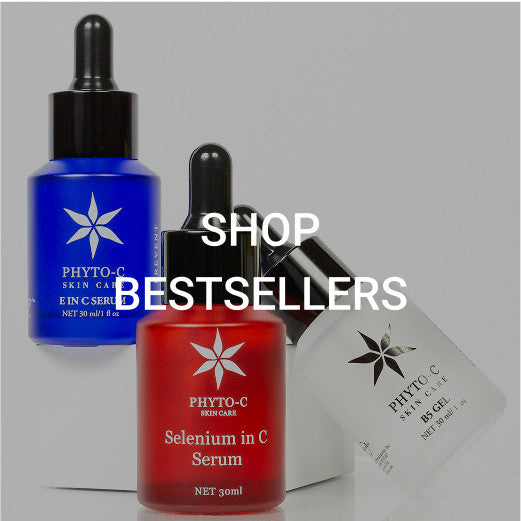
Phyto-C serums containing bioflavonoids include Serum Fifteen (15% LAA), Serum Twenty (20% LAA), E in C Advanced (20% LAA + 5% vitamin E), E in C Lite (10% LAA + 5% vitamin E), Selenium in C Serum (15% LAA + retinol + selenium), and HYPER-C (concentrated booster). Choose based on your experience level and skin goals: Serum Twenty for maximum-strength pure LAA, E in C Advanced for vitamin C plus vitamin E synergy, or Selenium in C Serum for a multi-antioxidant approach that includes retinol.
The bioflavonoids and vitamin C skin benefits documented in decades of research are not incidental — they reflect a fundamental principle of antioxidant chemistry that informed Dr. Omar's original patents and continues to define Phyto-C's formulation approach. Experience this synergy firsthand with Serum Twenty, the flagship 20% L-ascorbic acid serum built on the science that started it all.
 Next Post