

 My Account
 Our Story
 The Science
 Shipping Information
 Returns
 FAQ
FAQ VIP Rewards
 Contact Us

Vitamin C Serum for Mature Skin: Clinical Guide
Choosing the right vitamin C serum for mature skin is not a matter of brand loyalty or marketing appeal — it is a matter of formulation science. After age 40, collagen loss accelerates, cumulative photodamage compounds, and the skin's capacity to absorb and utilize active ingredients diminishes. A vitamin C serum formulated with the wrong derivative, at the wrong pH, or at an insufficient concentration will not deliver meaningful results. This guide breaks down exactly what mature skin needs from a vitamin C serum — and which Phyto-C formulations meet the clinical standard.
Why Mature Skin Needs Vitamin C More Than Any Other Age Group
Collagen production declines roughly 1–1.5% per year after age 30, and this decline accelerates noticeably after 40. L-ascorbic acid is a required cofactor for prolyl hydroxylase and lysyl hydroxylase — the enzymes responsible for stabilizing procollagen molecules. Without adequate L-ascorbic acid at the dermal level, new collagen formation slows further. Research published in the Journal of the American Academy of Dermatology, including work from Dr. Mostafa Omar's NCI-funded research at Duke University, demonstrated that topical L-ascorbic acid at the correct pH and concentration supports measurable procollagen synthesis in human skin.
Mature skin also carries decades of cumulative UV exposure. Ultraviolet radiation generates reactive oxygen species that degrade existing collagen and elastin fibers while accelerating melanocyte irregularity. Vitamin C is one of the most potent aqueous-phase antioxidants in human skin, and its topical application helps neutralize these free radicals before they cause structural damage. For a deeper understanding of this mechanism, read how L-ascorbic acid supports collagen synthesis in aging skin.
Reduced epidermal turnover in mature skin — often 50% slower than in younger adults — means that the delivery vehicle and formulation pH matter more, not less. An effective vitamin C serum must penetrate a thicker, more compacted stratum corneum. This is why formulation science is the determining factor in whether a vitamin C product works for aging skin or simply sits on its surface.
What Should You Look for in a Vitamin C Serum for Mature Skin?
Concentration: The clinically validated range for topical L-ascorbic acid is 15–20%. Below 10%, the antioxidant and collagen-supporting effects are significantly reduced. Above 20%, increased irritation potential offers diminishing returns. Vitamin C derivatives — such as ascorbyl glucoside, magnesium ascorbyl phosphate, and sodium ascorbyl phosphate — lack the bioavailability and peer-reviewed evidence to justify their use. They do not penetrate effectively, and their conversion rates to active L-ascorbic acid in skin are insufficient for clinical outcomes.
pH: L-ascorbic acid must be formulated at a pH below 3.5 to cross the stratum corneum in its active, non-ionized form. A formula at pH 5 or above is functionally inert regardless of its stated vitamin C concentration. For a complete breakdown of why pH is the single most important factor in vitamin C serum efficacy, see Vitamin C Serum pH: Why It Determines If It Works.
Form: Only pure L-ascorbic acid in an aqueous solution has the clinical literature to support its use for aging skin. Phyto-C was founded in 1995 by Dr. Mostafa Omar, whose NCI-funded, JAAD-published research at Duke University established the foundational science for topical L-ascorbic acid efficacy. That research remains the gold standard. For the full scientific context, read L-Ascorbic Acid: The Science Behind Vitamin C's Gold Standard.
Which Phyto-C Vitamin C Serum Is Right for Your Mature Skin?
Not every mature skin type needs the same serum. The right choice depends on your tolerance level, the severity of photodamage, and whether you need complementary actives alongside L-ascorbic acid.
Serum Twenty delivers 20% pure L-ascorbic acid with sodium hyaluronate and bioflavonoids in an alcohol-free base. It is the highest-concentration pure vitamin C serum in the Phyto-C line. For tolerant mature skin seeking maximum collagen support and visible brightening, this is the clinical benchmark.
Serum Fifteen uses the identical formula at 15% L-ascorbic acid. It is ideal for mature skin with mild sensitivity or for those building tolerance before advancing to 20%.
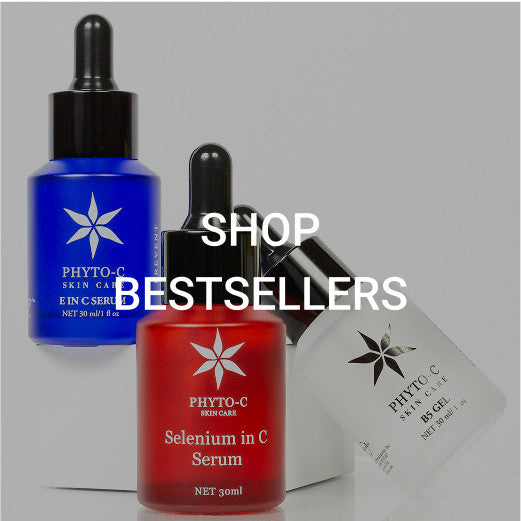
E in C Advanced, invented by Dr. Eddie Omar, combines 20% L-ascorbic acid with 5% vitamin E (alpha-tocopherol) and bioflavonoids. The synergy between vitamins C and E amplifies antioxidant defense — vitamin E protects cell membranes while vitamin C regenerates oxidized vitamin E. This serum contains alcohol and is suited for mature skin with significant photodamage. Learn more about this synergy in our guide to vitamin E and vitamin C skin protection.
Selenium in C Serum provides a triple antioxidant system: 15% L-ascorbic acid, 1% vitamin E, 1% selenium (L-selenomethionine), and 1% retinol with bioflavonoids. This is a strong option for mature skin dealing with both uneven pigmentation and firmness loss.
| Feature | Serum Twenty | E in C Advanced | Selenium in C |
|---|---|---|---|
| L-Ascorbic Acid Concentration | 20% | 20% | 15% |
| Vitamin E | No | 5% | 1% |
| Retinol | No | No | 1% |
| Selenium | No | No | 1% |
| Contains Alcohol | No | Yes | Yes |
| Primary Benefit | Maximum LAA collagen support | CE antioxidant synergy | Triple antioxidant + retinol |
| Best Candidate | Tolerant mature skin, alcohol-free preference | Photodamaged mature skin | Mature skin with pigmentation + firmness concerns |
How to Layer Vitamin C Into a Mature Skin Routine
Morning application is optimal. L-ascorbic acid neutralizes free radicals generated by UV radiation and environmental pollutants throughout the day. Applying vitamin C at night is not harmful, but it underutilizes the ingredient's primary protective function.
Morning sequence: Soothing Cleanser → Balancing Toner (primes pH for vitamin C absorption) → Vitamin C serum (Serum Twenty or your chosen formula) → Moisturizer → SPF. Skipping the toner or applying vitamin C over a high-pH moisturizer reduces penetration. For the full clinical morning protocol, see Vitamin C Serum With SPF: The Clinical Morning Routine.
Vitamin C pairs naturally with hyaluronic acid to maintain moisture in aging, barrier-compromised skin. HYPER Hydrate, invented by Dr. Eddie Omar, delivers H2A2 hyaluronic acid with niacinamide and pantothenic acid for deep hydration layered alongside your serum. For daytime moisturizing, Intensive Hydrating Cream — also formulated by Dr. Eddie Omar — provides vitamin E, ceramide 3, and pantothenic acid to support the skin's moisture barrier.
In the evening, mature skin benefits from retinol or peptides that complement vitamin C's daytime collagen-supporting work. Retinol 0.5% or HYPER Lift (a peptide firming treatment invented by Dr. Eddie Omar) can anchor an evening routine focused on visible firmness and texture improvement.
What Are the Most Common Mistakes Mature Skin Users Make With Vitamin C?
Using derivatives instead of L-ascorbic acid. Ascorbyl glucoside, magnesium ascorbyl phosphate, and tetrahexyldecyl ascorbate are frequently marketed as "stable vitamin C alternatives." They are not clinically equivalent. None has demonstrated the collagen-supporting or brightening efficacy of pure L-ascorbic acid in peer-reviewed research. Read Vitamin C Derivatives Don't Work: Here's the Case Against Them for the full scientific argument.
Applying to wet or alkaline skin. Water on the skin's surface dilutes the serum and raises the pH above the absorption threshold. Pat skin dry after cleansing and toning before applying your vitamin C serum.
Improper storage. L-ascorbic acid is sensitive to heat, light, and air. Storing your serum in a bathroom cabinet exposed to steam and temperature fluctuations accelerates oxidation. Amber glass or opaque packaging helps, but cool, dark storage is essential — especially in warmer months. For seasonal storage guidance, see Vitamin C Serum in Summer: Storage, Oxidation & Heat.
Expecting overnight results. Clinical studies consistently show that meaningful changes in collagen density, pigmentation, and skin texture from topical L-ascorbic acid require 8–12 weeks of consistent, daily use. Mature skin may take longer due to slower cellular turnover. Patience and consistency are non-negotiable.
Frequently Asked Questions
Is 20% vitamin C too strong for mature or sensitive skin?
Not necessarily. Mature skin with no active sensitivity or barrier disruption typically tolerates 20% L-ascorbic acid well. If you experience tingling or mild irritation, start with Serum Fifteen at 15% and build tolerance over two to four weeks before advancing to Serum Twenty.
Can I use a vitamin C serum every day if my skin is mature and thin?
Yes. Daily application is how L-ascorbic acid builds its protective reservoir in skin tissue. If your skin feels sensitive, apply every other day for the first two weeks and increase to daily use as tolerance builds. An alcohol-free formula like Serum Twenty is well suited for thinner, more delicate mature skin.
Should I use vitamin C in the morning or evening for anti-aging benefits?
Morning is optimal. L-ascorbic acid's primary function as a free radical scavenger is most useful during daytime exposure to UV radiation and environmental pollutants. Evening routines benefit more from retinol or peptides that support skin renewal during sleep.
Does vitamin C serum help with deep wrinkles or only fine lines?
L-ascorbic acid helps improve the appearance of fine lines by supporting collagen synthesis and providing antioxidant defense. Deep wrinkles involve structural dermal changes that no topical ingredient can fully reverse. However, consistent vitamin C use helps minimize the look of fine lines and supports a firmer, more even-toned complexion over time.
What is the difference between Serum Twenty and E in C Advanced for aging skin?
Serum Twenty delivers 20% L-ascorbic acid with sodium hyaluronate and bioflavonoids in an alcohol-free formula. E in C Advanced, invented by Dr. Eddie Omar, adds 5% vitamin E for enhanced antioxidant synergy but contains alcohol. For mature skin with photodamage, E in C Advanced provides stronger combined antioxidant support. For those who prefer an alcohol-free formula or have barrier sensitivity, Serum Twenty is the better fit.
Mature skin has the most to gain from a properly formulated vitamin C serum — and the most to lose from a poorly formulated one. Start with Phyto-C Serum Twenty or the formula matched to your skin's needs above, and give it the 8–12 weeks of consistent use that clinical science demands.
 Next Post