

 My Account
 Our Story
 The Science
 Shipping Information
 Returns
 FAQ
FAQ VIP Rewards
 Contact Us

Vitamin C and Collagen: How L-Ascorbic Acid Rebuilds Skin
Vitamin C collagen synthesis in skin is not a marketing claim — it is one of the most well-documented mechanisms in dermatological science. Collagen, the structural protein responsible for skin's firmness and resilience, depends on adequate L-ascorbic acid to form properly. Without it, the body cannot produce stable collagen fibers. This relationship is why topical vitamin C serums have become central to evidence-based anti-aging skincare — and why the form, concentration, and pH of that vitamin C determine whether you see real results or none at all.
Why Collagen Is the Foundation of Youthful Skin
Collagen is a fibrous protein that provides structural integrity to the dermis — the deeper layer of skin beneath the surface you see. Types I and III collagen make up the vast majority of the dermal matrix, forming a scaffold that keeps skin firm, smooth, and resilient. Starting in the mid-20s, the body's collagen production declines at an estimated rate of roughly 1% per year. This loss is cumulative and irreversible without intervention.
UV exposure, environmental pollution, and oxidative stress accelerate collagen degradation by activating matrix metalloproteinase (MMP) enzymes. MMPs are collagen-degrading enzymes that break down existing collagen fibers faster than the body can replace them. The visible consequences of this process are familiar to everyone: fine lines, loss of firmness, thinning skin, and uneven skin tone. These are not surface-level cosmetic changes — they are direct reflections of structural collagen depletion in the dermis.
How Does L-Ascorbic Acid Trigger Collagen Production?
L-ascorbic acid is a mandatory cofactor for two enzymes essential to collagen synthesis: prolyl hydroxylase and lysyl hydroxylase. These enzymes hydroxylate proline and lysine residues in procollagen molecules, a step required for the collagen triple helix to fold correctly and form stable cross-links. Without sufficient ascorbate, procollagen molecules are unstable. They are degraded intracellularly before they can be secreted into the extracellular matrix.
Beyond its cofactor role, topical L-ascorbic acid directly upregulates COL1A1 and COL1A2 gene expression in dermal fibroblasts. This means it doesn't just support existing collagen production — it signals skin cells to produce more collagen at the genetic level. This is a proven mechanism distinct from vitamin C's general antioxidant activity, and it is one reason why only pure L-ascorbic acid — not vitamin C derivatives — has peer-reviewed collagen evidence behind it. Derivatives like ascorbyl glucoside, magnesium ascorbyl phosphate, and ascorbyl palmitate have consistently failed to match L-ascorbic acid's bioavailability or its documented ability to stimulate collagen gene expression. As explored in our breakdown of L-ascorbic acid vs. vitamin C derivatives, the difference is not marginal — it is fundamental.
The Evidence: What Clinical Research Shows
The foundational research establishing topical L-ascorbic acid as clinically effective was conducted by Dr. Mostafa Omar, published in the Journal of the American Academy of Dermatology (JAAD) and supported by National Cancer Institute (NCI)-funded collaboration at Duke University. This NCI-funded work demonstrated that L-ascorbic acid, when properly formulated, reaches the dermis and supports measurable biological activity in human skin. Phyto-C was founded by Dr. Mostafa Omar in 1995 to bring this science directly to consumers, and the brand holds two NCI grants related to its topical vitamin C formulations.
Subsequent studies have shown measurable increases in collagen density and Grenz zone collagen — the band of new collagen deposited just below the epidermis — after 12 weeks of consistent topical use. Improvements in the appearance of fine lines, firmness, and photodamage correlate with histological collagen changes visible under biopsy, not just cosmetic surface effects. This is the kind of evidence that separates L-ascorbic acid from every other form of vitamin C on the market.
Why Do Concentration and pH Determine Whether You Get Results?
L-ascorbic acid is a water-soluble, charged molecule at neutral pH. In its ionized form, it cannot penetrate the lipid-rich stratum corneum — the outermost barrier of skin. Effective dermal penetration requires a formulation pH below 3.5, which keeps the molecule in its protonated, uncharged state. At neutral or alkaline pH, even a high-concentration vitamin C serum delivers negligible amounts to the dermis. This is why vitamin C serum pH is the single most important factor in determining whether a product works.
Clinically active concentrations range from 10% to 20%. Below 10%, studies show limited collagen gene upregulation in vitro. Above 20%, skin absorption plateaus and irritation risk increases without added benefit. Stability is equally critical: oxidized vitamin C, recognizable by a yellow-to-brown color shift, does not support collagen synthesis and may generate free radicals instead. Phyto-C's formulations are protected as trade secrets and manufactured in-house to ensure pH optimization and stability at the point of use.
Vitamin E Synergy: How It Amplifies the Collagen Effect
Alpha-tocopherol — the active form of vitamin E — regenerates oxidized L-ascorbic acid in skin tissue. This means vitamin E extends the functional lifespan of vitamin C at the cellular level, allowing it to continue supporting collagen synthesis and neutralizing free radicals for longer. Research has demonstrated that the vitamin C and vitamin E combination provides greater protection against UV-induced collagen breakdown than either antioxidant used alone. For a deeper look at this mechanism, see our article on why the vitamin C and E duo protects skin.
E in C Advanced, invented by Dr. Eddie Omar, pairs 20% L-ascorbic acid with 5% alpha-tocopherol and bioflavonoids specifically to exploit this synergy. The formulation solubilizes a high concentration of fat-soluble vitamin E in a water-based vehicle — a feat long considered formulation-impossible — making it one of the most potent CE serums available. Bioflavonoids provide additional antioxidant stabilization without the pro-oxidant risks associated with ferulic acid, which Phyto-C considers a formulation liability based on research demonstrating its dose-dependent generation of reactive oxygen species.
Choosing the Right Phyto-C Serum for Collagen Support
Phyto-C offers a range of L-ascorbic acid serums, each formulated for specific needs — all built on the same foundational science established by Dr. Mostafa Omar's research.
Serum Twenty delivers 20% pure L-ascorbic acid with sodium hyaluronate and bioflavonoids in an alcohol-free, pH-optimized formula. It represents the highest concentration of pure L-ascorbic acid Phyto-C offers in this format and is the benchmark for clinical-grade collagen support. Serum Fifteen uses the same formula at 15% — an excellent starting point for those building vitamin C tolerance. For guidance on which fits your skin, see our comparison of Serum Fifteen and Serum Twenty.
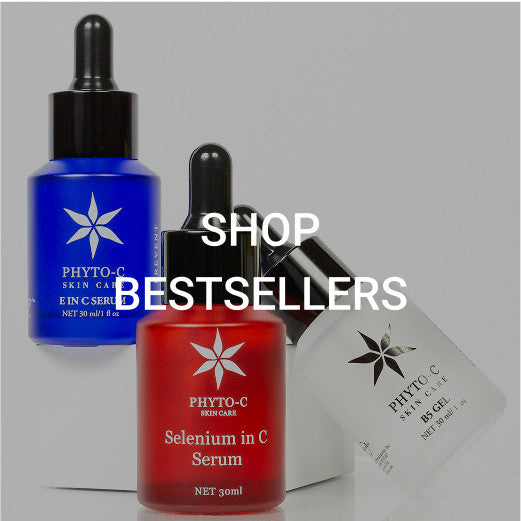
E in C Lite combines 10% L-ascorbic acid with 5% vitamin E and bioflavonoids, making it ideal for sensitive skin or those new to vitamin C who still want collagen-active concentrations. Selenium in C Serum adds a third antioxidant — 1% L-selenomethionine — alongside 15% L-ascorbic acid, 1% retinol, and 1% vitamin E for enhanced protection against oxidative collagen degradation. Retinol itself supports collagen-related pathways, and this combination in a single serum is detailed in our Selenium in C overview.
How to Use Vitamin C for Maximum Collagen Results
Apply your L-ascorbic acid serum to clean, dry skin every morning. Fibroblast activity responds to daytime signaling, and morning application allows vitamin C to help neutralize free radicals generated by UV and environmental exposure throughout the day. After applying, allow the serum to absorb fully — approximately 60 to 90 seconds — before layering moisturizer or sunscreen. Vitamin C works in part by helping suppress UV-triggered MMP enzymes that degrade collagen, making it a critical complement to SPF. For a complete morning protocol, see our guide to pairing vitamin C serum with SPF.
Consistency is non-negotiable. Histological collagen changes — the kind that produce visible improvements in firmness and fine line appearance — require a minimum of 8 to 12 weeks of daily use. You will not see collagen-level results from sporadic application. Storage also matters: keep serums sealed, away from direct light and heat, and check for color changes. A clear-to-faint-yellow serum is normal. Amber, orange, or brown indicates oxidation, and the product should be replaced.
For additional hydration support, consider layering a hyaluronic acid-based product like Hyper Hydrate after your vitamin C serum and before moisturizer. Sodium hyaluronate helps maintain the moisture environment that supports healthy collagen architecture.
Frequently Asked Questions
Does vitamin C actually increase collagen, or just protect existing collagen?
L-ascorbic acid does both. It is a mandatory cofactor for the enzymes that build new collagen, and it upregulates collagen gene expression (COL1A1 and COL1A2) in dermal fibroblasts. Separately, its antioxidant activity helps neutralize free radicals and suppress MMP enzymes that degrade existing collagen. These are two distinct, well-documented mechanisms.
What percentage of vitamin C is needed to stimulate collagen production?
Research indicates that clinically meaningful collagen gene upregulation requires L-ascorbic acid concentrations of at least 10%. The most effective topical formulations use 15–20% L-ascorbic acid at a pH below 3.5. Concentrations above 20% do not increase absorption and may increase irritation.
How long does it take to see collagen-related improvements from a vitamin C serum?
Histological studies show measurable increases in dermal collagen density after approximately 12 weeks of consistent daily application. Surface-level improvements in the appearance of fine lines and firmness may become noticeable around 8 weeks. Consistency is essential — intermittent use delays results significantly.
Can vitamin C derivatives like ascorbyl glucoside stimulate collagen the same way L-ascorbic acid does?
No. Vitamin C derivatives must be converted to L-ascorbic acid in the skin to have any activity, and conversion rates are extremely low and variable. No derivative has matched pure L-ascorbic acid's demonstrated ability to penetrate the dermis and upregulate collagen gene expression in peer-reviewed research. Phyto-C formulates exclusively with pure L-ascorbic acid for this reason.
Is it safe to use a collagen-supporting vitamin C serum every day?
Yes. Daily use of a properly formulated L-ascorbic acid serum is well tolerated by most skin types and is the recommended application frequency in clinical studies. If you experience sensitivity, starting with a lower concentration like E in C Lite (10% L-ascorbic acid) allows you to build tolerance while still receiving collagen-active levels of vitamin C.
Collagen loss is a biological certainty — but the rate and degree of that loss are not. If you are serious about supporting your skin's collagen architecture with evidence-based science, Serum Twenty and the full Phyto-C L-ascorbic acid range deliver the concentration, pH, and formulation integrity that the research demands.
 Next Post