
 My Account
 Our Story
 The Science
 Shipping Information
 Returns
 FAQ
FAQ VIP Rewards
 Contact Us

Selenium in Skincare: The Antioxidant Mineral Explained
Selenium in skincare remains one of the most underappreciated strategies for defending skin against daily oxidative assault. While vitamins C and E dominate antioxidant conversations, selenium — an essential trace mineral — operates through an entirely different enzymatic mechanism that neither vitamin can replicate. Understanding how this mineral functions topically, which form delivers meaningful results, and why it performs best alongside complementary antioxidants is critical for anyone building a serious, evidence-based skincare regimen.
What Is Selenium and Why Does Skin Need It?
Selenium is an essential trace mineral required for the proper function of selenoproteins — a family of enzymes that serve as the body's endogenous antioxidant defense system. The most important of these in skin is glutathione peroxidase, an enzyme that catalyzes the reduction of hydrogen peroxide and lipid hydroperoxides into harmless water and alcohol molecules. Without adequate selenium, glutathione peroxidase cannot function efficiently, leaving skin cells vulnerable to unchecked free radical damage.
Topically, selenium supports this enzymatic pathway directly within the skin tissue where oxidative stress occurs. UV exposure, environmental pollution, and the skin's own metabolic processes continuously generate reactive oxygen species (ROS) that deplete selenium reserves in the epidermis and dermis. Over time, this depletion compromises the skin's ability to neutralize free radicals at the cellular level — a deficit that no amount of surface-level moisturizing can address. Replenishing selenium topically helps restore the enzymatic infrastructure that skin relies on to maintain its integrity against environmental stressors.
L-Selenomethionine: The Bioavailable Form for Topical Use
Not all forms of selenium are equally effective in skincare. L-Selenomethionine is an organic, amino acid-bound form of selenium that demonstrates superior skin penetration compared to inorganic selenium salts such as sodium selenite or selenium sulfide. Its molecular structure — selenium bonded to the amino acid methionine — allows it to be recognized and absorbed by the skin's protein synthesis machinery, rather than sitting inertly on the surface.
This amino acid integration is what distinguishes L-selenomethionine from cheaper selenium sources. Because the skin can incorporate selenomethionine into its own proteins, the antioxidant activity is sustained over time rather than limited to a brief, transient effect at the moment of application. The selenium becomes functionally embedded in the tissue, supporting glutathione peroxidase cycles as long as the selenoproteins remain active.
Published research suggests that L-selenomethionine at a concentration of 1% provides meaningful photoprotective and antioxidant activity in skin. This is the precise concentration used in Selenium in C Serum, formulated to deliver a clinically relevant dose — not a token amount included for label appeal. The distinction between a functional concentration and a marketing trace amount is one that separates serious formulations from superficial ones.
How Selenium Pairs With Vitamin C and Vitamin E
The rationale for combining selenium with vitamins C and E is grounded in their complementary antioxidant mechanisms. Each operates in a different phase and through a different pathway, meaning the combination provides broader-spectrum free radical defense than any single ingredient alone.
Vitamin E (alpha-tocopherol) is lipid-soluble, positioning itself within cell membranes where it quenches lipid peroxidation — the chain reaction that damages membrane integrity. However, once vitamin E neutralizes a free radical, it becomes oxidized and temporarily inactive. This is where selenium enters the cycle: glutathione peroxidase, powered by selenium, participates in the regeneration of oxidized vitamin E back to its active form. Without selenium, vitamin E's protective capacity is significantly limited.
L-Ascorbic Acid — pure vitamin C — independently scavenges aqueous-phase free radicals in the water-soluble compartments of cells. Research published in the Journal of the American Academy of Dermatology, building on foundational work by Dr. Mostafa Omar, demonstrated that L-ascorbic acid at optimal pH supports collagen synthesis and provides measurable antioxidant protection. The triple combination of L-ascorbic acid, vitamin E, and selenium creates a synergistic antioxidant network that addresses free radical damage across aqueous, lipid, and enzymatic pathways simultaneously.
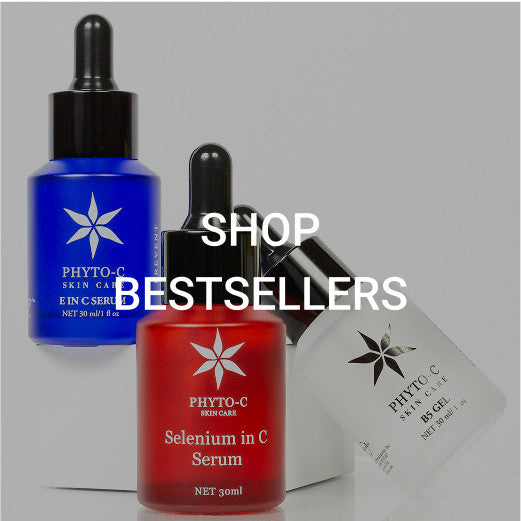
Selenium in C Serum delivers exactly this triple antioxidant system: 15% L-Ascorbic Acid, 1% Vitamin E, 1% Selenium as L-Selenomethionine, and bioflavonoids for additional polyphenolic support. Phyto-C stabilizes its vitamin C formulations with bioflavonoids — plant-derived polyphenolic compounds — rather than ferulic acid, which Phyto-C and Dr. Omar consider a potential pro-oxidant. Research by Lee (2005) in Archives of Pharmacal Research demonstrated that ferulic acid can induce dose-dependent generation of reactive oxygen species via NADPH oxidase activation, a risk that runs counter to the purpose of an antioxidant serum.
Selenium's Role in Photoprotection and Anti-Aging
UV radiation generates superoxide anions and hydroxyl radicals — among the most destructive ROS — that directly damage DNA, degrade collagen fibers, and oxidize lipid membranes. Selenium's enzymatic defense, mediated through glutathione peroxidase and thioredoxin reductase, targets precisely these reactive species at the intracellular level where the damage originates.
Research also suggests that selenium may help reduce UV-induced immunosuppression in skin. UV exposure doesn't just cause visible damage — it suppresses the skin's local immune response, compromising its natural repair processes. By supporting enzymatic antioxidant pathways, selenium helps preserve the biological environment in which the skin can maintain its own defense and renewal functions.
Long-term cumulative oxidative damage is a primary driver of the visible signs of aging: collagen degradation, loss of elasticity, and uneven pigmentation. Selenium helps slow this cascade by neutralizing free radicals before they initiate the enzymatic breakdown of structural proteins. For those concerned with pigmentation, pairing selenium-based protection with targeted brightening actives — such as the alpha-arbutin and kojic acid found in Phyto Gel — can address both the cause and the visible consequence of oxidative skin damage.
One critical clarification: selenium is not a sunscreen. It does not absorb or reflect UV radiation. It functions as a biological antioxidant complement to physical UV protection — never a replacement. Broad-spectrum SPF remains essential, and selenium works beneath that shield to address the free radicals that inevitably penetrate even the best sunscreen.
Who Should Consider a Selenium-Containing Serum?
A selenium antioxidant serum is ideal for adults with a history of significant sun exposure, those living in high-pollution environments, or anyone observing early signs of oxidative aging — fine lines, uneven tone, and loss of radiance that suggest cumulative free radical damage beneath the surface.
Because Selenium in C Serum also contains 15% L-Ascorbic Acid and 1% Retinol, it is a comprehensive, multi-active formulation suited for experienced skincare users. This is not a beginner's product. It is best suited for those who have already built tolerance to vitamin C and retinol individually and are ready to consolidate their antioxidant protocol into a single, synergistic step.
Those with very sensitive skin or no prior vitamin C experience should consider starting with a gentler entry point — such as E in C Lite, which delivers 10% L-Ascorbic Acid and 5% Vitamin E without retinol — before progressing to the full triple-antioxidant system. Alternatively, Serum Fifteen offers a clean 15% L-Ascorbic Acid formula with sodium hyaluronate and bioflavonoids, allowing users to establish vitamin C tolerance before introducing additional actives.
For those integrating retinol into their regimen alongside Selenium in C Serum, supporting the skin's moisture barrier is essential. A ceramide-rich moisturizer like SuperHeal O-Live Cream — formulated with ceramides, vitamin E, olive leaf extract, and pantothenic acid — can help maintain barrier integrity during active treatment phases. For lighter hydration needs, Hyper Hydrate delivers H2A2 Hyaluronic Acid with niacinamide and pantothenic acid to reinforce moisture retention without heaviness.
Frequently Asked Questions
Is selenium safe to apply topically to the face?
Yes. L-Selenomethionine, the organic form of selenium used in well-formulated skincare, has a strong safety profile at concentrations up to 1%. It is an amino acid-bound mineral that the skin can integrate into its own protein structures. This is fundamentally different from inorganic selenium compounds, which can be irritating at higher concentrations.
What is the difference between selenium and selenomethionine in skincare?
Selenium is the mineral element; selenomethionine is the bioavailable, organic form in which selenium is bound to the amino acid methionine. L-Selenomethionine penetrates skin more effectively than inorganic selenium salts like sodium selenite because its amino acid structure allows it to be recognized and absorbed by the skin's biological pathways. In a topical formulation, the form of selenium matters as much as the presence of selenium itself.
Can selenium in a serum replace the need for SPF?
No. Selenium is not a sunscreen and does not absorb or block UV radiation. It functions as an intracellular antioxidant that helps neutralize the free radicals generated by UV exposure. Selenium complements broad-spectrum SPF by addressing oxidative damage at the enzymatic level, but it cannot substitute for physical or chemical UV protection.
How does selenium interact with Vitamin C in the same formula?
Selenium and L-Ascorbic Acid operate through different antioxidant mechanisms that are complementary rather than redundant. L-Ascorbic Acid scavenges free radicals in the aqueous phase of cells, while selenium powers glutathione peroxidase — an enzyme that neutralizes hydrogen peroxide and lipid hydroperoxides. Together with Vitamin E, they form a triple antioxidant network that covers aqueous, lipid, and enzymatic defense pathways simultaneously.
How often should you use a selenium antioxidant serum?
A selenium-containing serum like Selenium in C Serum is typically applied once daily in the morning, before moisturizer and sunscreen, to provide antioxidant defense during the hours of greatest environmental exposure. Because this particular formula also contains 1% retinol, some users may benefit from gradual introduction — starting with every other day and building to daily use as the skin acclimates. Consult your skincare professional for personalized guidance based on your skin's current tolerance.
Selenium remains one of the most scientifically compelling — and most overlooked — antioxidant minerals in topical skincare. For those ready to move beyond basic vitamin C into a truly synergistic antioxidant protocol, Phyto-C's Selenium in C Serum delivers the triple-antioxidant network of L-Ascorbic Acid, Vitamin E, and L-Selenomethionine in a single, purposefully formulated step — built on more than two decades of Dr. Mostafa Omar's foundational research in topical antioxidant science.
 Next Post