
 My Account
 Our Story
 The Science
 Shipping Information
 Returns
 FAQ
FAQ VIP Rewards
 Contact Us

Why Ferulic Acid Is Pro-Oxidant (And What to Use Instead)
Ferulic acid is one of the most widely used ingredients in modern vitamin C serums — and one of the least questioned. But the assumption that ferulic acid is a reliable antioxidant stabilizer deserves scrutiny: research demonstrates that ferulic acid can behave as a ferulic acid pro-oxidant, generating the very free radicals it's marketed to neutralize. Understanding this risk is essential for anyone serious about building a vitamin C routine grounded in science rather than trend.
What Is Ferulic Acid and Why Is It Everywhere?
Ferulic acid is a plant-derived phenolic compound found in grains, fruits, and vegetables. It gained mainstream popularity in topical skincare after a 2005 Duke University study promoted the idea that adding ferulic acid to a vitamin C and E formulation could enhance photoprotection and improve formula stability. Almost overnight, the "C+E+Ferulic" combination became an industry standard — copied by dozens of brands and accepted as near-gospel by consumers and professionals alike.
What's rarely discussed is how much of this standard rests on a single formulation study, with limited independent replication of its specific synergistic claims. The skincare industry adopted ferulic acid as a category ingredient largely on momentum, not on a broad, independently verified body of evidence. Most consumers — and even many estheticians — assume ferulic acid is universally beneficial. The science, however, tells a more complicated and more cautionary story.
The Pro-Oxidant Problem: What the Science Shows
Antioxidants are not always antioxidants. This is a fundamental principle of redox biochemistry that the skincare industry frequently ignores. Under certain conditions — UV exposure, elevated temperatures, the presence of transition metal ions, or high local concentrations — phenolic compounds like ferulic acid can undergo a shift from antioxidant to pro-oxidant behavior. Instead of neutralizing free radicals, they generate reactive oxygen species (ROS).
This is not speculation. Lee (2005), published in Archives of Pharmacal Research, demonstrated that ferulic acid induces dose-dependent generation of reactive oxygen species via NADPH oxidase activation. The study provided clear mechanistic evidence that ferulic acid, under biologically relevant conditions, can drive oxidative stress rather than quench it. Pro-oxidant behavior in polyphenolic compounds is, in fact, a well-established phenomenon across the antioxidant biochemistry literature — it is the rule under certain conditions, not the exception.
The risk compounds when ferulic acid is combined with L-ascorbic acid, which is itself a redox-active molecule capable of cycling between oxidized and reduced states. If formulation pH, oxygen exposure, or photostability is not precisely controlled — and most commercial formulas degrade with use, light exposure, and time — the combination of ferulic acid and L-ascorbic acid can create conditions favorable to pro-oxidant cycling. In plain terms: the ingredient marketed as a protector may, over the life of the product, become a source of the damage it claims to prevent.
This is not a fringe concern. It is the scientific basis for Phyto-C's deliberate, decades-long exclusion of ferulic acid from every formula in its line.
Why Phyto-C Excludes Ferulic Acid by Design
Phyto-C's formulation philosophy was built by Dr. Mostafa Omar, the scientist credited with pioneering stable liquid L-ascorbic acid for topical use. Dr. Omar's foundational research — conducted at Duke University with NCI funding and published in the Journal of the American Academy of Dermatology (JAAD) — established the parameters for effective topical vitamin C delivery: pure L-ascorbic acid, at concentrations of 15–20%, at a pH below 3.5. That research forms the scientific backbone of Phyto-C's formulations, protected as proprietary trade secrets refined over more than two decades.
Phyto-C's position on ferulic acid is unambiguous: it is unnecessary when L-ascorbic acid is correctly formulated at the optimal pH. The "stability problem" ferulic acid purports to solve is, in Phyto-C's view, a formulation engineering problem — one better addressed through precise pH control, appropriate vehicle selection, and antioxidant co-factors that do not carry pro-oxidant liability. Adding ferulic acid to a vitamin C serum is, from this perspective, introducing risk to solve a problem that proper formulation science already handles.
This is a brand-defining scientific stance rooted in decades of antioxidant chemistry expertise — not a marketing differentiator chosen for shelf appeal. As discussed in our deep dive on bioflavonoids and their synergy with vitamin C, the alternatives Phyto-C has chosen are not compromises. They are deliberate, evidence-based selections.
What Phyto-C Uses Instead: Bioflavonoids and Synergistic Antioxidants
Rather than relying on ferulic acid, Phyto-C serums incorporate bioflavonoids — a class of plant-derived polyphenolic antioxidants with a long safety record and demonstrated ability to support vitamin C activity without pro-oxidant risk. Bioflavonoids work synergistically with L-ascorbic acid to help neutralize free radicals and support the skin's antioxidant defense network. They appear across Phyto-C's core vitamin C line, including Serum Twenty, Serum Fifteen, and the HYPER-C Booster.
Vitamin E (alpha-tocopherol) provides a second layer of antioxidant synergy. The vitamin C + E pairing is supported by independent research showing that these two antioxidants regenerate each other within the skin's lipid and aqueous compartments, delivering complementary free-radical defense. Phyto-C's E in C Advanced — invented by Dr. Eddie Omar, Phyto-C's CEO — solubilizes 5% alpha-tocopherol alongside 20% L-ascorbic acid in a water-based vehicle, a formulation long considered impossible. For those with sensitive skin, E in C Lite delivers the same C+E synergy at a gentler 10% L-ascorbic acid concentration. You can read more about why the vitamin C and E duo helps protect skin.
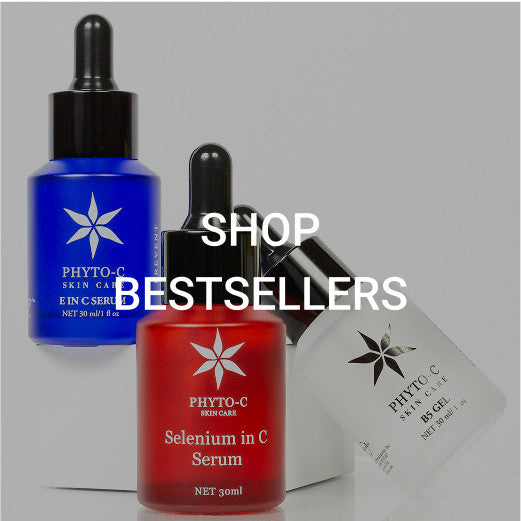
For those seeking an even broader antioxidant system, Selenium in C Serum adds L-selenomethionine — a bioavailable form of selenium that supports glutathione activity and functions as a mineral antioxidant co-factor at the cellular level. Combined with 15% L-ascorbic acid, 1% retinol, and 1% vitamin E, it delivers a triple antioxidant architecture with no ferulic acid in sight. Learn more about selenium as a topical antioxidant.
This multi-antioxidant strategy delivers layered free-radical defense using ingredients with established, predictable behavior across a wide range of real-world conditions — heat, light, air exposure, and extended shelf life.
How to Choose a Vitamin C Serum Without Ferulic Acid
If you're looking for the best vitamin C serum without ferulic acid, start with the ingredient list. Ferulic acid appears under its own INCI name, and it's present in many of the most popular C+E serums on the market. Its inclusion is often marketed as a "stability enhancer" — language that frames ferulic acid as essential rather than optional, and obscures its pro-oxidant potential.
Next, look for pH-controlled L-ascorbic acid formulas. Effective topical L-ascorbic acid requires a pH below 3.5 for adequate skin penetration — this is well-established in published dermatology research. Brands that engineer their formulas for proper pH stability from the outset do not need ferulic acid as a stabilizing crutch. pH engineering is the solution; ferulic acid is a workaround with side effects.
Prioritize serums that use bioflavonoids, vitamin E, or selenium as synergistic antioxidants. These ingredients offer comparable or superior support profiles without the documented pro-oxidant risk of ferulic acid. Serum Twenty is Phyto-C's highest-concentration pure L-ascorbic acid serum — 20% LAA with sodium hyaluronate and bioflavonoids, no alcohol, no ferulic acid. It represents the cleanest expression of Dr. Mostafa Omar's original research translated into a daily-use formula.
For a comprehensive guide on building a safe, effective antioxidant routine, see our article on how to stack skincare for maximum antioxidant results. And if you're new to vitamin C serums, our guide on how to choose the right vitamin C serum for your skin walks through concentration, formulation type, and skin compatibility considerations.
Frequently Asked Questions
Is ferulic acid safe to use in skincare?
Ferulic acid is permitted in cosmetic formulations and is not banned by any regulatory body. However, "permitted" does not mean "optimal." Published research, including Lee (2005) in Archives of Pharmacal Research, has demonstrated that ferulic acid can generate reactive oxygen species in a dose-dependent manner via NADPH oxidase activation. Phyto-C excludes ferulic acid from all formulations based on its potential pro-oxidant behavior under real-world conditions.
Why do so many vitamin C serums contain ferulic acid if it can be pro-oxidant?
The widespread use of ferulic acid traces back to a single influential 2005 study that popularized the C+E+Ferulic combination. The formulation became an industry template, and many brands replicated it without independently verifying the specific synergistic claims or weighing the pro-oxidant risk data. Market momentum, not broad scientific consensus, drives ferulic acid's prevalence in vitamin C serums today.
What is the difference between an antioxidant and a pro-oxidant?
An antioxidant donates electrons to neutralize free radicals, helping protect cells from oxidative damage. A pro-oxidant does the opposite — it generates free radicals or reactive oxygen species, contributing to oxidative stress. Many compounds, including phenolic antioxidants like ferulic acid, can switch between antioxidant and pro-oxidant behavior depending on concentration, pH, the presence of metal ions, and environmental conditions such as UV exposure.
Does Phyto-C use ferulic acid in any of its products?
No. Phyto-C does not use ferulic acid in any product. This is a deliberate formulation decision based on Dr. Mostafa Omar's assessment that ferulic acid introduces unnecessary pro-oxidant risk. Phyto-C uses bioflavonoids as its primary antioxidant support system for L-ascorbic acid, alongside vitamin E and selenium in select formulas.
What should I look for in a vitamin C serum instead of ferulic acid?
Look for pure L-ascorbic acid at a concentration between 10% and 20%, formulated at a pH below 3.5 for effective skin penetration. The serum should include stable antioxidant co-factors such as bioflavonoids, vitamin E (alpha-tocopherol), or selenium — ingredients that support L-ascorbic acid without pro-oxidant liability. Avoid vitamin C derivatives, which have not demonstrated equivalent bioavailability or efficacy compared to pure L-ascorbic acid in published research.
The ferulic acid question isn't about choosing fear over science — it's about choosing better science. When L-ascorbic acid is formulated correctly, with antioxidant co-factors that behave predictably across conditions, ferulic acid becomes not just unnecessary but counterproductive. Explore Phyto-C's Serum Twenty and the full vitamin C line to experience what two decades of research-driven formulation looks like — no ferulic acid required.
 Next Post