
 My Account
 Our Story
 The Science
 Shipping Information
 Returns
 FAQ
FAQ VIP Rewards
 Contact Us

Can You Use Vitamin C and Retinol Together?
The question of whether you can use vitamin C and retinol together is one of the most persistent debates in skincare — and one of the most misunderstood. The short answer is yes. The nuanced answer is that pH, formulation quality, and your skin type matter far more than the pairing itself. Phyto-C has built two multi-active serums — SuperHeal O-Live Serum and Selenium in C Serum — that co-formulate both actives in a single step, proving the combination is not only possible but clinically purposeful.
The Short Answer: Yes — With the Right Protocol
The myth that vitamin C and retinol are chemically incompatible has circulated in skincare circles for years. It has no solid scientific foundation. What is true is that both actives require careful formulation to perform at their best. L-ascorbic acid — pure vitamin C — must be formulated at a pH below 3.5 to penetrate the skin and deliver measurable results. Retinol requires a stable, protective vehicle to prevent degradation. Neither of these requirements makes the two actives incompatible with each other. The real concern has always been poorly stabilized vitamin C, not the combination itself. When a vitamin C formula is properly stabilized — as Phyto-C's are, using bioflavonoids rather than potentially pro-oxidant additives — there is no inherent reason it cannot coexist with retinol in a well-designed system.
What Happens When L-Ascorbic Acid and Retinol Meet?
L-ascorbic acid is water-soluble and pH-dependent. It requires an acidic environment to remain stable and bioavailable. Retinol is lipophilic — it is oil-soluble and travels through the lipid layers of the skin via a different pathway. Because they operate through distinct solubility mechanisms, the two do not meaningfully compete for absorption when the formulation is handled correctly.
The concern most often raised is oxidation: that retinol might destabilize vitamin C, or vice versa. In a low-quality formula with poor antioxidant support, this is a real risk. But the culprit is an unstabilized vitamin C base — not the presence of retinol. A vitamin C serum that is already prone to oxidation will degrade whether or not retinol is present. Phyto-C formulas use bioflavonoids as antioxidant co-factors precisely because they support vitamin C stability without introducing the pro-oxidant risks associated with ferulic acid. Research published in Archives of Pharmacal Research (Lee, 2005) demonstrated that ferulic acid can induce dose-dependent generation of reactive oxygen species — a risk Phyto-C has deliberately avoided. For a deeper look at why L-ascorbic acid is the gold standard among vitamin C forms, the science is well established.
Two Ways to Use Both: Separate Products vs. Combined Formula
There are two practical approaches to incorporating both vitamin C and retinol into a routine.
Option 1: Layer separately. Apply your vitamin C serum first, immediately after cleansing and toning. At a pH below 3.5, it will absorb efficiently into clean skin. Allow two to three minutes for absorption before applying your retinol product. This approach gives each active its optimal application window and is well-suited to those who want to customize concentrations independently.
Option 2: Use a single co-formulated serum. This eliminates the guesswork entirely. When a skilled formulator has already optimized the pH, vehicle, and antioxidant system to support both actives simultaneously, there is no layering risk and no compatibility concern for the user. Phyto-C offers two serums that achieve exactly this: SuperHeal O-Live Serum and Selenium in C Serum.
SuperHeal O-Live Serum: Vitamin C + Retinol + Brightening in One
SuperHeal O-Live Serum is Phyto-C's most comprehensive single-serum treatment. Its active profile includes 15% L-ascorbic acid, 1% retinol, 1% vitamin E, olive leaf extract, alpha-arbutin, and kojic acid. This is not a product that simply combines two well-known actives and calls it a day. It is a deliberately layered antioxidant and brightening system: L-ascorbic acid supports collagen synthesis and helps neutralize free radicals; retinol promotes visible skin renewal; olive leaf extract provides additional antioxidant support; and alpha-arbutin and kojic acid work in concert to help minimize the look of uneven tone and dark spots. For a closer look at how these brightening agents compare, see Kojic Acid vs. Alpha-Arbutin: Which Brightener Wins?
This serum is best suited to oily, acne-prone, or hyperpigmentation-focused skin types that can tolerate a more active formula. It does contain alcohol, which contributes to its fast-absorbing, lightweight texture — but makes it less appropriate for those with a compromised moisture barrier or sensitivity concerns. If your skin runs dry or reactive, the alcohol content is worth noting before you commit.
Selenium in C: Triple Antioxidant Meets Retinol
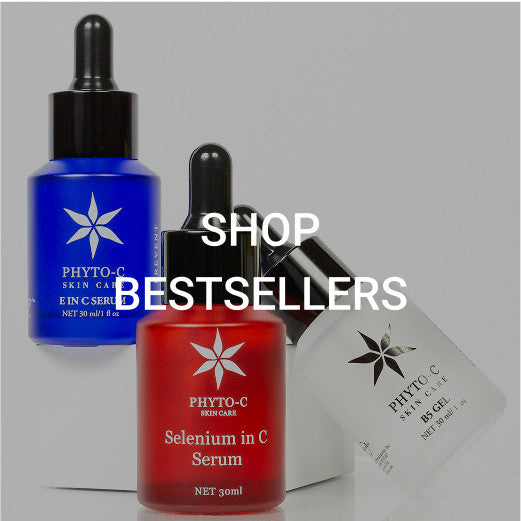
Selenium in C Serum was formulated by Dr. Mostafa Omar — the same scientist whose NCI-funded research at Duke University established the foundational science behind topical L-ascorbic acid, published in the Journal of the American Academy of Dermatology. It is the only Phyto-C serum that pairs L-ascorbic acid with retinol and adds selenium (as L-selenomethionine) as a third antioxidant co-factor. The active profile: 15% L-ascorbic acid, 1% retinol, 1% vitamin E, and 1% selenium, stabilized with bioflavonoids.
Selenium is a trace mineral with well-documented antioxidant properties. As a component of selenoproteins, it plays a role in the body's oxidative stress response. In a topical context, Phyto-C's inclusion of L-selenomethionine alongside vitamin C and retinol creates what is arguably the most antioxidant-comprehensive serum in the Phyto-C lineup. It is best suited to photoaged or sun-damaged skin, or to those seeking the broadest possible free-radical defense in a single product. For more on selenium's role in skin protection, read Selenium in Skincare: The Antioxidant Mineral Explained.
The Layering Protocol If You Choose Separate Products
For those who prefer to keep vitamin C and retinol in separate products, a time-separation approach works well. Use your vitamin C serum in the morning — L-ascorbic acid helps neutralize free radicals generated by UV and environmental exposure throughout the day, making it a logical component of a morning antioxidant routine. Apply retinol in the evening, when skin enters its natural repair cycle and there is no UV exposure to interact with photosensitive retinol molecules.
This AM/PM split is particularly useful for beginners, those building retinol tolerance, or anyone using a high-concentration vitamin C serum such as Serum Twenty who wants to keep the formulas distinct. If you are unsure which vitamin C concentration to start with, What Percentage Vitamin C Serum Should You Use? provides clear clinical guidance.
The combined-formula approach is preferable when you want to simplify your routine, when you are confident your skin can tolerate a more active formula, or when your primary concern — hyperpigmentation, photoaging, or dullness — benefits from simultaneous delivery of both actives.
Who Should Avoid This Combination?
Not every skin type is ready for vitamin C and retinol together, regardless of the delivery method. Three groups in particular should approach with caution.
Compromised barrier or active sensitivity: If your skin barrier is already stressed — visible redness, tightness, flaking — adding retinol to your routine will likely compound the irritation before resolving it. Restoring barrier integrity first is always the right clinical move. Intensive Hydrating Cream, formulated by Dr. Eddie Omar with ceramides, vitamin E, and pantothenic acid, supports barrier repair without over-activing skin in recovery.
Vitamin C beginners: If you are new to L-ascorbic acid, starting with both actives at once adds unnecessary variables. Begin with a gentler vitamin C formula — E in C Lite, Dr. Eddie Omar's 10% L-ascorbic acid and 5% vitamin E serum formulated for sensitive or first-time users, is the logical entry point. For comprehensive guidance, see E in C Lite: The Vitamin C Serum for Sensitive Skin.
Post-procedure skin: After chemical peels, laser treatments, or microneedling, the skin barrier is temporarily disrupted. Reintroducing retinol before the barrier has fully recovered can cause unnecessary sensitivity. Allow adequate healing time, reintroduce vitamin C first, then layer in retinol once skin has normalized. For timing guidance, see Vitamin C After Chemical Peel: Post-Procedure Protocol.
Frequently Asked Questions
Can you use vitamin C serum and retinol in the same routine?
Yes. Vitamin C and retinol can be used in the same routine when they are either properly layered (vitamin C first, retinol after absorption) or co-formulated in a single serum designed for both actives. The incompatibility myth stems from concerns about formula instability — not a fundamental chemical conflict between the two ingredients.
Which Phyto-C serum contains both vitamin C and retinol?
Phyto-C offers two serums that co-formulate L-ascorbic acid and retinol: SuperHeal O-Live Serum (15% L-ascorbic acid, 1% retinol, 1% vitamin E, olive leaf extract, alpha-arbutin, and kojic acid) and Selenium in C Serum (15% L-ascorbic acid, 1% retinol, 1% vitamin E, and 1% selenium). Both are formulated without vitamin C derivatives and without ferulic acid.
Does vitamin C deactivate retinol when layered together?
No. L-ascorbic acid and retinol operate through different solubility pathways — L-ascorbic acid is water-soluble and pH-dependent; retinol is lipophilic. They do not deactivate each other when properly formulated. The concern is rooted in poorly stabilized vitamin C formulas, not in an inherent incompatibility between the two molecules.
Should I use vitamin C in the morning and retinol at night?
This is the most common and practical separation protocol. Vitamin C in the morning supports antioxidant defense against daily UV and environmental stressors. Retinol in the evening aligns with the skin's natural renewal cycle and avoids UV-related retinol degradation. For those using a co-formulated serum like SuperHeal O-Live Serum, time separation is not necessary.
Is SuperHeal O-Live Serum or Selenium in C better for anti-aging?
Both serums support visible anti-aging benefits through their shared foundation of 15% L-ascorbic acid and 1% retinol. Selenium in C adds a third antioxidant layer — L-selenomethionine — making it particularly well-suited to photoaged or sun-damaged skin seeking comprehensive free-radical defense. SuperHeal O-Live Serum adds brightening agents (alpha-arbutin, kojic acid) and olive leaf extract, making it the stronger choice for hyperpigmentation, uneven tone, or acne-related discoloration.
The combination of vitamin C and retinol is not a skincare experiment — it is a clinically purposeful pairing that Phyto-C has refined across more than two decades of formulation science. Whether you choose to layer separately or simplify with a co-formulated serum, the key is working with actives that are properly stabilized and correctly pH-optimized. Explore SuperHeal O-Live Serum and Selenium in C Serum to find the approach that fits your skin.
 Next Post