
 My Account
 Our Story
 The Science
 Shipping Information
 Returns
 FAQ
FAQ VIP Rewards
 Contact Us

How Long Does Vitamin C Serum Last? Shelf Life & Storage
How long does vitamin C serum last? It is one of the most practical questions in skincare — and one with a real, science-backed answer that most brands prefer to gloss over. L-ascorbic acid is the most potent, best-studied form of topical vitamin C, but that potency comes with a trade-off: it is chemically reactive, and that reactivity means it degrades over time. Understanding that degradation process — and what to do about it — is the difference between getting full value from your serum and applying expensive, inert liquid to your face.
Why Does Vitamin C Serum Expire Faster Than Other Serums?
L-ascorbic acid (LAA) is a powerful antioxidant precisely because it readily donates electrons to neutralize free radicals. That same electron-donating chemistry is what makes it unstable in a bottle. When LAA is exposed to oxygen, light, or heat, it oxidizes — first converting to dehydroascorbic acid (DHAA), a form that still has limited biological activity, and then degrading further into diketogulonic acid. That second conversion is the point of no return. Diketogulonic acid has no antioxidant function, no ability to support collagen synthesis, and no skin-brightening activity. The serum has not just weakened — it has fundamentally ceased to be what it was.
This is why vitamin C serums expire faster than, say, a peptide serum or a hyaluronic acid product. Those ingredients are chemically stable. L-ascorbic acid is not. Its instability is not a formulation failure — it is the direct consequence of the reactivity that makes it work. The goal of expert formulation is to manage that instability, not eliminate it.
How Long Does Vitamin C Serum Actually Last? Typical Timelines
Unopened and stored correctly, a clinical-grade L-ascorbic acid serum typically remains effective for 2 to 3 years from the manufacture date. Once opened, most LAA serums have a usable window of 3 to 6 months — after which oxidative degradation begins to meaningfully reduce active concentration.
Formulation pH plays a direct role in that window. Research — including the foundational work conducted by Dr. Mostafa Omar, whose NCI-funded studies on topical L-ascorbic acid were published in the Journal of the American Academy of Dermatology — established that LAA is most stable, and most bioavailable, at a pH below 3.5. Phyto-C serums including Serum Twenty, Serum Fifteen, and E in C Advanced are formulated within that low-pH window, which both maximizes skin penetration and slows the rate of oxidative degradation.
One common misconception is that a higher-concentration serum expires faster. A 20% L-ascorbic acid formula does not oxidize at a meaningfully faster rate than a 15% formula, provided the underlying formulation is sound. Concentration determines potency. Formulation determines stability. They are separate variables.
The 5 Warning Signs Your Vitamin C Serum Has Oxidized
Your serum will tell you when it has turned. You just need to know the signs.
- Color change. Fresh LAA serums are clear to pale yellow. As oxidation progresses, the color shifts: pale yellow → amber → orange → brown. A brown serum is fully spent. Do not continue using it.
- Smell change. A properly formulated L-ascorbic acid serum has almost no smell at full potency. An oxidized serum develops a faint metallic, sour, or slightly rancid odor. Trust your nose.
- Texture change. If a serum that was previously clear and thin has become cloudy, thickened, or has developed visible particulates, oxidation and formula breakdown are likely underway.
- Reduced tingling on application. The mild tingling that many users notice with low-pH vitamin C serums is partly a function of active LAA concentration. If that sensation has faded noticeably, it can signal a drop in active potency.
- Plateau in visible results. If your skin's brightness and tone-evening progress stalls suddenly without any other explanation, consider the age of your open serum. Oxidation is a quiet process — the bottle looks fine right up until it doesn't.
For a broader look at what oxidation looks like in practice, see our dedicated guide: Why Did My Vitamin C Serum Turn Brown? Oxidation Explained.
How to Store Vitamin C Serum to Maximize Its Shelf Life
Oxidation requires three things: oxygen, heat, and light. Eliminate exposure to all three as much as possible and your serum will last longer.
- Keep it away from light. UV exposure is a direct catalyst for LAA oxidation. Opaque or amber glass packaging is a deliberate design choice — not aesthetic. Store your serum in a drawer or cabinet, not on a sunlit vanity.
- Control temperature. Store below 77°F (25°C). The bathroom is often the worst place for a vitamin C serum — heat and steam from showers accelerate degradation significantly. A bedroom dresser drawer is a better option than a bathroom shelf.
- Close the cap immediately. Every second the bottle sits open, oxygen enters. Make it a habit: apply, then close. This single practice extends shelf life more than any other.
- Consider refrigerator storage. Cold temperatures slow oxidation. Refrigerating an opened serum can extend its effective life by 1 to 2 months. One caution: repeated temperature cycling causes condensation inside the bottle, which dilutes and destabilizes the formula. If you refrigerate, store the serum in a small sealed bag to minimize moisture entry.
- Never top up an old bottle. Mixing a new serum into a bottle that still contains oxidized product contaminates the fresh formula immediately. When you open a new bottle, it gets its own fresh start.
For more guidance on protecting your serum during warmer months, see: Vitamin C Serum in Summer: Storage, Oxidation & Heat.
Does a Slightly Yellow Serum Still Work? What the Science Says
Yes — with an important caveat. Pale yellow is the natural color of L-ascorbic acid in aqueous solution at meaningful concentrations. A fresh, properly formulated vitamin C serum is not water-clear. Light yellow is normal and expected. It does not indicate oxidation has begun.
The degradation curve is not linear. A lightly yellowed serum retains the vast majority of its active concentration. The drop-off in efficacy accelerates significantly once the color shifts past yellow into amber, and becomes steep as it approaches orange. By brown, the useful activity of the serum is effectively zero.
Phyto-C's choice of bioflavonoids — rather than ferulic acid — as antioxidant stabilizers is directly relevant here. Bioflavonoids are plant-derived polyphenolic compounds that help protect L-ascorbic acid from oxidative degradation without introducing the pro-oxidant risk associated with ferulic acid. Research including Lee (2005) in Archives of Pharmacal Research demonstrated that ferulic acid can induce dose-dependent generation of reactive oxygen species via NADPH oxidase activation — a risk Phyto-C has specifically formulated to avoid. For a deeper read on this, see: Bioflavonoids in Skincare: Why They Protect Vitamin C.
The practical takeaway: pale yellow is fine. Amber is a warning. Brown is done. When genuine doubt exists, replace the serum. The cost of a fresh bottle is trivial compared to weeks of applying an ingredient that is no longer active.
Which Phyto-C Vitamin C Serums Have the Best Stability Profile?
Serum Twenty and Serum Fifteen represent the most straightforward stability profile in the Phyto-C lineup. Both are alcohol-free, formulated at low pH, and stabilized with bioflavonoids. Fewer co-ingredients means fewer variables that can compromise the formula over time. They are direct expressions of Dr. Mostafa Omar's foundational LAA research — clean, clinical, and built to last. For a detailed look at these two serums, see Serum Twenty: The 20% Vitamin C Serum for Serious Results and Serum Fifteen: The 15% Vitamin C Serum That Delivers.
E in C Advanced — formulated by Dr. Eddie Omar, CEO and Chief Scientist of Phyto-C — combines 20% L-ascorbic acid with 5% alpha-tocopherol (Vitamin E) in a water-based vehicle, a formulation feat long considered technically impossible. The vitamin C and vitamin E pairing provides mutual antioxidant protection: vitamin C regenerates oxidized vitamin E, and the presence of vitamin E in the formula adds an additional layer of oxidative resilience.
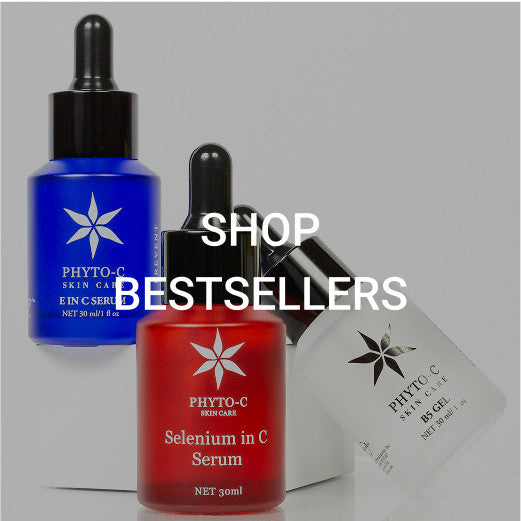
Selenium in C extends this logic further with a triple antioxidant system — L-ascorbic acid, vitamin E, and selenium (L-selenomethionine) — offering additional oxidative resilience from multiple angles. It is among the most comprehensively protected formulas in the line.
A practical note on purchasing: buy a bottle size appropriate to your actual usage rate. A 1 oz bottle used daily will be finished well within the optimal 3-month window. A 2 oz bottle used only on weekends may not. Matching bottle size to usage frequency is one of the simplest ways to ensure you are always applying an active, effective formula.
Frequently Asked Questions
How long does an opened vitamin C serum last?
Most clinical-grade L-ascorbic acid serums remain effective for 3 to 6 months after opening when stored correctly — away from heat, light, and air exposure. Refrigeration can extend the usable window by an additional 1 to 2 months. Once the serum shifts from pale yellow to amber or darker, the active concentration has declined significantly and the serum should be replaced.
Can I still use a vitamin C serum that has turned orange?
An orange-colored vitamin C serum has undergone substantial oxidative degradation and will deliver meaningfully less benefit than a fresh formula. At the orange stage, L-ascorbic acid has largely converted to diketogulonic acid, which has no documented antioxidant or collagen-supporting activity. It is best to replace it with a fresh bottle rather than continue using a compromised product.
Should I refrigerate my vitamin C serum?
Refrigerating an opened vitamin C serum can slow oxidation and extend its effective shelf life by 1 to 2 months. The main risk is condensation — repeated temperature changes allow moisture to enter the bottle, which can dilute and destabilize the formula. If you refrigerate your serum, store it inside a small sealed bag to reduce this risk.
Does a higher percentage vitamin C serum expire faster?
No. A 20% L-ascorbic acid serum does not oxidize at a faster rate than a 15% serum if the underlying formulation is sound. Concentration and stability are separate variables. Stability is determined by pH, stabilizer system, packaging, and storage conditions — not by the percentage of L-ascorbic acid in the formula.
How do I know if my Phyto-C vitamin C serum is still effective?
A fresh Phyto-C vitamin C serum is clear to pale yellow, nearly odorless, and produces a mild tingling sensation on application. If your serum has shifted to amber or deeper in color, developed a metallic or sour odor, or if the tingling sensation has noticeably diminished, the active concentration has likely declined. When in doubt, replace it — an oxidized vitamin C serum cannot deliver the results a fresh formula provides.
Vitamin C serum shelf life is not a mystery once you understand the chemistry behind it. L-ascorbic acid degrades predictably — but the right formulation, the right storage habits, and the right eye for early warning signs keep that chemistry working in your favor for as long as possible. Phyto-C's vitamin C serums are formulated from the ground up to maximize both potency and stability — starting with Serum Twenty, the 20% L-ascorbic acid formula that has anchored the brand's clinical lineup since Dr. Mostafa Omar's foundational research. If you are ready to get full value from every drop, start there.
 Next Post