
 My Account
 Our Story
 The Science
 Shipping Information
 Returns
 FAQ
FAQ VIP Rewards
 Contact Us

Best Professional Vitamin C Serums: 2027 Buying Guide
The best professional vitamin C serum uses pure L-ascorbic acid at a low pH, provides an appropriate concentration, and is designed for reliable skin delivery. Choose the formula according to experience, sensitivity, supporting antioxidants, and whether the routine already includes strong actives such as retinol.
Finding the best vitamin C serum 2027 requires more than choosing the highest percentage on a label. A professional formula must deliver pure L-ascorbic acid in an appropriate chemical environment while balancing antioxidant support, tolerability, and the needs of the complete skin care routine.
Phyto-C was founded in 1995 by Dr. Mostafa Omar, whose foundational research on topical L-ascorbic acid was funded by the National Cancer Institute and published in the Journal of the American Academy of Dermatology with Duke University and Dr. Sheldon Pinnell. Phyto-C holds two NCI grants related to topical vitamin C formulations, while more than two decades of proprietary formulation knowledge are protected as trade secrets.
This vitamin C serum buying guide applies evidence-based formulation criteria to six Phyto-C options. Each serum uses pure L-ascorbic acid rather than a vitamin C derivative, but the concentrations, supporting antioxidants, and intended routines differ.
What Makes the Best Vitamin C Serum 2027 Worth Buying?
A professional vitamin C serum should be judged by the form of vitamin C, concentration, pH, supporting ingredients, delivery system, and overall formulation quality. No single number can establish whether a serum will perform well for a particular person.
1. Pure L-ascorbic acid
L-ascorbic acid is pure vitamin C and the form supported by the strongest body of topical research. Phyto-C’s position is that vitamin C derivatives are not acceptable substitutes because they have not matched the bioavailability and documented skin benefits of properly formulated L-ascorbic acid. The detailed evidence is reviewed in What Is L-Ascorbic Acid? The Only Vitamin C With Real Evidence.
Research published in JAAD demonstrated that topical L-ascorbic acid under appropriate formulation conditions supports collagen synthesis. As an antioxidant, it also helps neutralize free radicals and supports brighter, more even-looking skin. These research findings describe the ingredient science and do not mean that every formula containing vitamin C will produce equivalent results.
2. An appropriate concentration
Concentration describes how much L-ascorbic acid is present, but it does not independently determine absorption, visible performance, or tolerability. A 10% formula may be appropriate for sensitive skin, while a well-tolerated 15% or 20% formula may better suit an experienced user seeking more intensive antioxidant support.
Higher is not automatically better. A serum that causes persistent discomfort or cannot be used consistently offers limited practical value. Formulation variables such as pH, solvent system, complementary antioxidants, packaging, and the condition of the skin’s moisture barrier all matter.
3. Low-pH delivery
pH measures how acidic or alkaline a formula is. L-ascorbic acid works best when formulated below pH 3.5 because this acidic environment supports its availability to the skin. A high percentage in an unsuitable pH environment may not provide the expected delivery.
Bioavailability means the amount of an ingredient that can reach the site where it can function. Consumers and professionals can explore what actually controls topical vitamin C absorption for a closer examination of concentration, pH, and formulation design.
4. Purposeful antioxidant support
Complementary antioxidants should serve a clear formulation purpose. Phyto-C uses bioflavonoids, which are plant-derived polyphenolic compounds that provide antioxidant support. Learn more about bioflavonoids in vitamin C serums and their role in professionally designed formulas.
Phyto-C does not use ferulic acid. Dr. Omar considers it a potential pro-oxidant that can compromise formula integrity over time. Lee’s 2005 research in Archives of Pharmacal Research reported dose-dependent reactive oxygen species generation through NADPH oxidase activation, supporting Phyto-C’s decision to use bioflavonoids instead.
How to Choose the Best Vitamin C Serum 2027 from Phyto-C
The right Phyto-C serum depends on previous L-ascorbic acid experience, sensitivity, desired supporting antioxidants, and the presence of retinol or other strong actives. The table below compares six professional vitamin C serum options without assuming that one formula is universally best.
| Serum | Key actives | Best suited to | Important consideration |
|---|---|---|---|
| Serum Fifteen | 15% L-ascorbic acid, sodium hyaluronate, bioflavonoids | First-time users and users seeking a balanced daily concentration | Simple, alcohol-free formula |
| Serum Twenty | 20% L-ascorbic acid, sodium hyaluronate, bioflavonoids | Experienced users seeking Phyto-C’s highest pure L-ascorbic acid concentration | Simple, alcohol-free formula |
| E in C Lite | 10% L-ascorbic acid, 5% vitamin E, bioflavonoids | Sensitive skin and vitamin C beginners who want vitamin E support | Lower L-ascorbic acid concentration |
| E in C Advanced | 20% L-ascorbic acid, 5% vitamin E, bioflavonoids | Experienced users seeking concentrated vitamin C and vitamin E | Contains alcohol |
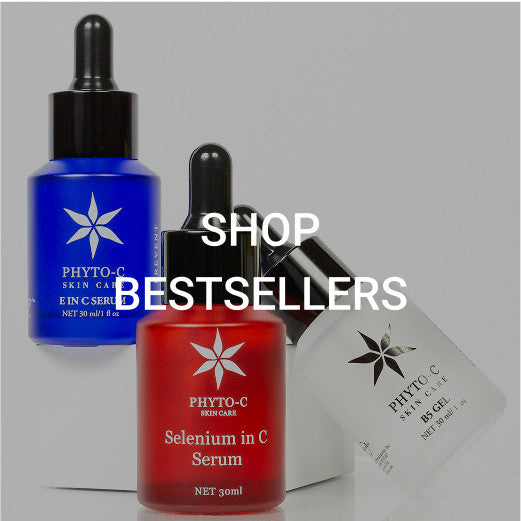
| Selenium in C Serum | 15% L-ascorbic acid, 1% retinol, 1% vitamin E, 1% selenium, bioflavonoids | Experienced users seeking a multi-antioxidant formula with retinol | Contains alcohol and retinol |
| SuperHeal O-Live Serum | 15% L-ascorbic acid, 1% retinol, 1% vitamin E, olive leaf extract, alpha-arbutin, kojic acid | Multi-active routines focused on brighter, more even-looking skin | Contains alcohol and several potent actives |
Serum Fifteen and Serum Twenty were invented by Dr. Mostafa Omar. Both combine pure L-ascorbic acid with sodium hyaluronate and bioflavonoids in alcohol-free formulas. Sodium hyaluronate is the sodium salt of hyaluronic acid and helps attract water to support hydrated-looking skin. The formulas differ primarily in their 15% and 20% L-ascorbic acid concentrations.
E in C Lite and E in C Advanced were invented by Dr. Eddie Omar, CEO and Chief Scientist of Phyto-C. He developed these novel water-based formulas to solubilize 5% fat-soluble vitamin E, a formulation challenge long considered impractical at such a high concentration. E in C Lite combines 10% L-ascorbic acid with 5% vitamin E for a gentler entry point, while E in C Advanced combines 20% L-ascorbic acid with 5% vitamin E for experienced users.
Selenium in C Serum builds on Dr. Mostafa Omar’s foundational L-ascorbic acid research and combines vitamin C with retinol, vitamin E, selenium, and bioflavonoids. It is intended for users who understand how their skin responds to multiple active ingredients. Because it already contains 1% retinol, adding a separate retinol serum to the same application is generally unnecessary.
SuperHeal O-Live Serum is the most complex option in this comparison. It combines 15% L-ascorbic acid with retinol, vitamin E, olive leaf extract, alpha-arbutin, and kojic acid to help improve the appearance of uneven tone and texture. Users seeking alpha-arbutin and kojic acid without vitamin C or retinol may instead consider Phyto Gel, which contains 2% alpha-arbutin and 2% kojic acid.
What Are the Professional Buying Criteria for the Best Vitamin C Serum 2027?
Aesthetic professionals should assess the complete formula and the client’s routine rather than recommending vitamin C by percentage alone. A useful 2027 evaluation includes the following criteria:
- Confirm the vitamin C form. The label should identify pure L-ascorbic acid rather than a derivative such as sodium ascorbyl phosphate, magnesium ascorbyl phosphate, ascorbyl glucoside, or tetrahexyldecyl ascorbate.
- Evaluate concentration in context. Consider prior use, sensitivity, application frequency, climate, and concurrent exfoliants or retinoids.
- Verify low-pH formulation. Pure L-ascorbic acid requires a pH below 3.5 for appropriate topical availability.
- Review the full antioxidant system. Phyto-C relies on bioflavonoids and excludes ferulic acid because of its potential pro-oxidant behavior.
- Check for overlapping actives. Retinol, exfoliating acids, alpha-arbutin, and kojic acid may affect how frequently a serum should be introduced.
- Assess hydration support. Users needing additional moisture can pair a vitamin C serum with HYPER Hydrate, invented by Dr. Eddie Omar and formulated with H2A2 hyaluronic acid, niacinamide, L-proline, and pantothenic acid.
- Consider consistent use. A well-matched serum used regularly is more practical than a stronger formula that repeatedly causes discomfort.
Phyto-C’s formulation position aligns ingredient identity with delivery science. Pure L-ascorbic acid, adequate concentration, and low pH work as an integrated system. Vitamin C derivatives remain unacceptable substitutes because they have not demonstrated equivalent bioavailability or clinical evidence in skin.
Clinical evidence should also be interpreted precisely. Research findings about L-ascorbic acid cannot be automatically transferred to every serum bearing the words “vitamin C.” For a broader review, see Vitamin C in Dermatology: What Clinical Evidence Shows.
Frequently Asked Questions
What is the best vitamin C serum concentration for a first-time user?
A first-time user can often begin with 10% to 15% pure L-ascorbic acid, depending on sensitivity and the rest of the routine. E in C Lite provides 10% L-ascorbic acid with 5% vitamin E, while Serum Fifteen provides 15% L-ascorbic acid in a simple, alcohol-free formula.
Is 20% L-ascorbic acid better than 15% for every skin type?
No. A 20% L-ascorbic acid serum offers a higher concentration, but it is not automatically the best choice for every person. Experience, sensitivity, formula composition, pH, and consistent use should guide the choice between 15% and 20%.
What should aesthetic professionals evaluate before recommending a vitamin C serum?
Professionals should evaluate the vitamin C form, concentration, pH, supporting antioxidants, alcohol content, concurrent active ingredients, and the user’s previous tolerance. They should also distinguish research on pure L-ascorbic acid from marketing claims made for vitamin C derivatives.
Why does Phyto-C use L-ascorbic acid instead of vitamin C derivatives?
Phyto-C uses pure L-ascorbic acid because it is the form with demonstrated topical bioavailability and the strongest clinical evidence when formulated below pH 3.5. Derivatives have not matched pure L-ascorbic acid’s documented performance and are not considered acceptable substitutes by Phyto-C.
Which Phyto-C vitamin C serum should be used in a routine with retinol?
Users who want vitamin C and retinol in one formula can consider Selenium in C Serum or SuperHeal O-Live Serum, both of which already contain 1% retinol. Users applying a separate retinol product may prefer the retinol-free Serum Fifteen or Serum Twenty and introduce the products at different times according to tolerance.
The best professional vitamin C serum is the one that combines pure L-ascorbic acid, low-pH delivery, purposeful antioxidant support, and a concentration suited to the user. Compare Phyto-C’s professionally formulated vitamin C serums to select the option that fits your experience, sensitivity, and complete skin care routine.
